
PG25 coolant: which metals, gaskets and flanges are compatible
PG25, a 25 per cent propylene glycol mix, suits a liquid cooling loop only where every wetted part suits it too. The Open Compute Project lists the metals, elastomers and plastics that do, and the fluid limits that show when something in the loop is breaking down.
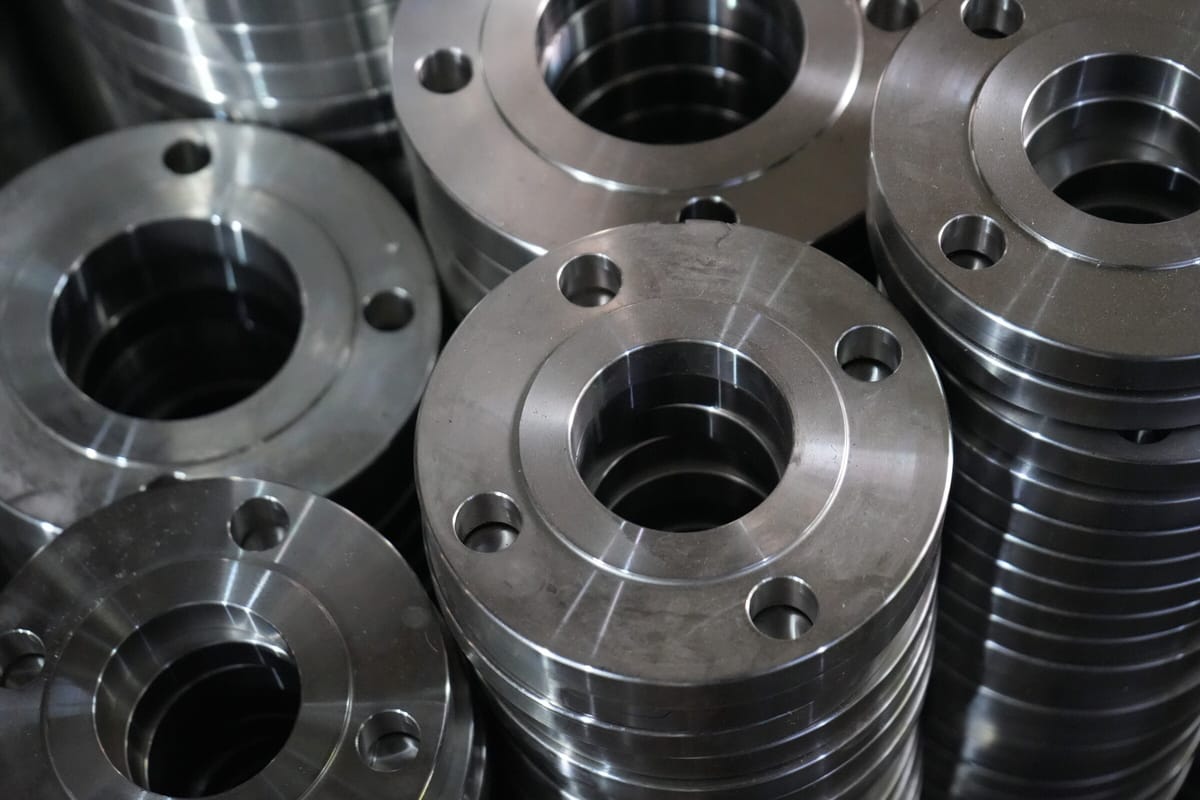
PG25 is an inhibited mix of about 25% propylene glycol and 75% water used in the technology cooling system (TCS) of direct-to-chip liquid cooling. The Open Compute Project's PG25 guidelines (Revision 2.0, September 2026) list 304L, 316L or higher stainless steel, copper, low zinc brass and titanium as compatible metals, EPDM, FKM and PTFE among the seals, and do not recommend carbon steel. For the flanges in a PG25 loop that means ASTM A182 F304L or F316L, which we forge, machine and supply pickled and passivated with EN 10204 3.1 certificates.
What PG25 is
PG25 is a ready-to-use heat transfer fluid: propylene glycol for freeze protection in shipping and storage and for its biostatic effect, demineralized water, and a corrosion inhibitor package, usually with an antifoam and a dye. It fills the closed loop between the coolant distribution unit (CDU) and the cold plates in the racks, the loop ASHRAE and OCP call the technology cooling system; the FWS vs TCS guide explains the two loops. The inhibitors work by forming a protective film on the metal, and they are used up slowly, which is why the fluid is sampled and topped up only with additives the fluid supplier approves.
| Property | Typical value | Test method |
|---|---|---|
| Propylene glycol | 24.5 to 27.5% by volume | ASTM E202 or D3321 |
| Freeze point | -13 to -10 °C (9 to 14 °F) | From ASTM D3321 |
| pH | 8.0 to 10.5 (conventional inhibitors); 7.0 to 10.5 (OAT) | ASTM D1287 |
| Total hardness (as CaCO3) | Under 25 ppm | ASTM D6130 |
| Sulfate | Under 10 ppm | ASTM D5827 |
| Chloride | Under 5 ppm | ASTM D5827 |
| Typical operating range of the loop | 17 to 66 °C (63 to 151 °F) | Section 6.6 |
Why the wetted materials decide whether PG25 works
Everything the fluid touches is a wetted material: cold plates, the CDU, hoses and piping, pump seals, heat exchangers and quick disconnect seals, and the flanges and gaskets that join the piping. The OCP guidelines put the duty to verify compatibility on the design engineer, the general contractor and then the operator, at the system's maximum operating temperature, and again whenever a component is replaced. A material that corrodes or leaches does two kinds of harm: it loses metal at the joint, and it puts ions such as iron, zinc or sulfate into a fluid whose inhibitors then deplete faster and whose particles end up in the microchannels of the cold plates.
Metals OCP lists as compatible with PG25
Table 3 of the guidelines is a representative list, not a complete one; other materials may be acceptable once verified.
| Metal | OCP guidance | Where it is used |
|---|---|---|
| Stainless steel | 304L, 316L or higher grades preferred; most stainless alloys acceptable, including 303 and 410 | TCS piping, row manifolds, flanges, CDU pipework, quick disconnects |
| Copper | CDA 110, 1020, 1100, 1220 | Cold plates, some heat exchangers |
| Brass | Under 15% zinc preferred; above 15% only if shown dezincification resistant (ISO 6509) | Fittings, valve bodies |
| Titanium | Grade 2 (UNS R50400) | Heat exchanger plates |
| Nickel and high nickel alloys | Avoid Hastelloy B and other alloys made for reducing environments | Special parts |
| Nickel or chromium plating | Avoid on quick connects until proven; worn plating exposes the base metal | Quick connects |
| Brazing alloys | B-Ni-6, BCuP-1 to BCuP-5, TF-H600F | Joints inside copper cold plates |
| Carbon steel | Not recommended in this application (section 10.7) | Belongs on the facility water side, not the TCS |
The stainless line is the one that matters for flanges: forged 304L and 316L flanges are the low carbon grades OCP prefers, and the low carbon content keeps the heat affected zone of a weld neck butt weld resistant to intergranular corrosion. The carbon steel note settles a question that comes up when a contractor wants to reuse a chilled water flange schedule: on the PG25 side of the CDU, carbon steel flanges are out, and the stainless vs carbon steel guide shows where each belongs.
How OCP tests corrosion: the limits stainless has to meet
For metals not already known to suit the fluid, the guidelines use ASTM D8040 with changes: pre-diluted PG25 tested as delivered with corrosive salts added (110 mg/L sodium chloride, 99 mg/L sodium sulfate, 92 mg/L sodium bicarbonate), coupons separated by PTFE spacers so they are not galvanically coupled, two weeks (336 hours) at 88 °C (190 °F) with continuous aeration.
| Metal | Corrosion rate, max | Weight loss per coupon, max |
|---|---|---|
| Copper (UNS C11000) | 0.2 mpy | 5 mg |
| Brass (UNS C26000) | 0.2 mpy | 5 mg |
| Stainless steel 304L | 0.1 mpy | 2 mg |
| Stainless steel 316L | 0.1 mpy | 2 mg |
The stainless limit is half the copper limit, and the guidelines note that the test's resolution concerns for copper do not apply to stainless alloys: 304L and 316L are expected to show next to no loss. Two cautions from the same section: the test is a screen, not a promise of long-term life, and it deliberately leaves out galvanic coupling. A loop with copper cold plates and stainless piping is a mixed-metal system that relies on the inhibitor; where a stainless flange meets a different metal outside that protection, our guide to dissimilar metal flange isolation covers the joint.
Gaskets and seals for PG25 flanges
| Material | OCP comment | Typical use at a flange |
|---|---|---|
| EPDM | Peroxide cured recommended; sulfur cured can release sulfate and should be used with caution | Full face and ring gaskets on Class 150 water and glycol joints |
| FKM | Viton A, GF and ETP types | O-rings, seals in pumps and quick disconnects |
| PTFE and FEP | Listed as compatible | PTFE envelope or expanded PTFE gaskets |
| PP, HDPE, PEEK | Listed as compatible | Plastic parts, filter housings, insulating sleeves |
| Thread sealants | Not covered; ask the sealant maker | Threaded vents and drains |
Ask the gasket supplier for peroxide cured EPDM by name, since an order for plain "EPDM" can be filled with either cure, and the sulfate a sulfur cured gasket gives off is one of the parameters the fluid analysis tracks. The OCP list is a starting point; compressed fiber sheet, for example, is not on it, so any material outside the list needs the gasket or fluid maker's confirmation at the loop's top temperature. Gasket types, facings and bolt loads are in our guide to flange gaskets for water and glycol.
Chloride, iron and the other numbers to watch
Most corrosion trouble in a PG25 loop starts with poor water: chloride and sulfate attack metal, hardness forms scale, and residual flush water dilutes the glycol. The guidelines set limits for the water used to flush and for the fluid in service.
| Parameter | Flush water | PG25 in service | Action in service |
|---|---|---|---|
| Chloride | Under 25 ppm | Under 25 ppm | Monitor 25 to 50 ppm; above 50 ppm consult the fluid supplier |
| Sulfate | Under 25 ppm | Under 25 ppm | Monitor 25 to 100 ppm; above 100 ppm consult the supplier |
| Iron | Under 2 ppm | Under 3 ppm | Above 5 ppm, sample more often |
| Copper | Not set | Under 3 ppm | Above 5 ppm, sample more often |
| Total hardness (as CaCO3) | Under 25 ppm | Under 50 ppm | Above 50 ppm, find the source |
| Conductivity | Under 25 µS/cm | Fluid specific | Per the fluid supplier |
| Propylene glycol | Not applicable | 24 to 29% by volume | Below 24% add concentrate; above 29% add pure water |
The chloride figures leave a wide margin for stainless: the Nickel Institute guidance puts the continuous limit at about 200 ppm for 304 and 1,000 ppm for 316 at neutral pH and room temperature, so a PG25 loop held under 25 ppm is far inside either, as our grade by loop table shows. Iron is the number that points at steel: a rising iron result in a stainless loop usually means carbon steel debris, a carbon steel part that should not be there, or iron left on the surface from fabrication.
From fabrication to fill: keeping flanges clean
The PG25 guidelines leave passivation of TCS piping to the OCP Modular TCS commissioning documents, but they set the order of work: clean, passivate if required, drain all flush water, then fill with ready-to-use fluid through filters (5 to 10 micron absolute is suggested), and check the glycol concentration at several points once the fluid has mixed. After the final flush the loop should be filled within 24 hours; a loop of only stainless steel, elastomers and plastics may stand open to air for up to 72 hours, and beyond that it is purged with nitrogen and sealed. Our TCS flushing guide covers the flush itself.
Flanges start that chain clean when they leave the forge clean. Stainless flanges for a PG25 loop can be supplied pickled and passivated to ASTM A380 or A967, which removes free iron and heat tint before they ever see the fluid; the pickling and passivation guide explains the two standards and how to write them on the order.
Section 5 of the guidelines asks operators to record the metals, elastomers and non-metallic materials in each system, with confirmation of their compatibility. For flanges the record is the EN 10204 3.1 certificate: grade, heat number, chemistry and tests, matched to the heat number stamped on each flange.
Specifying flanges for a PG25 loop
| Attribute | Usual choice | Why |
|---|---|---|
| Material | ASTM A182 F316L (F304L where the owner allows it) | Low carbon stainless, preferred by OCP, 0.1 mpy acceptance |
| Type | Weld neck to the pipe schedule; slip-on or lap joint on smaller lines | Full penetration butt weld, smooth bore for the flow |
| Class | ASME B16.5 Class 150 (PN 16 on EN projects) | F316L Class 150 is rated 15.9 bar (230 psi) at ambient, above usual TCS pressures |
| Facing | Raised face, smooth enough for a soft gasket | Suits EPDM and PTFE gaskets |
| Finish | Pickled and passivated (ASTM A380 or A967) | No free iron entering the fluid |
| Gasket | Peroxide cured EPDM or PTFE | On the OCP compatible list |
| Certificate | EN 10204 3.1 per heat | Feeds the operator's material record |
On the line item that reads, for example: "Weld neck flange, ASME B16.5, NPS 4 Class 150 RF, bore Sch 10S, ASTM A182 F316L, pickled and passivated to ASTM A967, EN 10204 3.1, for PG25 TCS service." The bore schedules are in our weld neck flange tables, and the technology cooling system page covers sizes and classes for the whole loop.
PG25 loops on European and Indian projects
Outside North America the TCS piping is often metric, and the flanges are EN 1092-1 type 11 weld neck flanges with a B1 raised face, PN 16 for most row and CDU loops. The OCP grades translate to European material numbers: 316L is 1.4404 and 304L is 1.4307, and either can be called up as ASTM A182 F316L or F304L where the CDU maker works to ASME. Where the Pressure Equipment Directive applies to main pressure parts (categories II to IV), the flange material needs a certificate of specific product control, such as EN 10204 3.1, from a manufacturer with a certified quality system; ours is certified by TÜV Rheinland Polska, so the same certificate serves the PED file and the operator's PG25 material record.
| DN | Pipe OD | Flange OD | Bolt circle | Bolts | Thickness C2 |
|---|---|---|---|---|---|
| 50 | 60.3 mm | 165 mm | 125 mm | 4 x M16 | 18 mm |
| 80 | 88.9 mm | 200 mm | 160 mm | 8 x M16 | 20 mm |
| 100 | 114.3 mm | 220 mm | 180 mm | 8 x M16 | 20 mm |
| 150 | 168.3 mm | 285 mm | 240 mm | 8 x M20 | 22 mm |
| 200 | 219.1 mm | 340 mm | 295 mm | 12 x M20 | 24 mm |
A metric line item: "Weld neck flange EN 1092-1/11/B1, DN 150 PN 16, neck to suit 168.3 mm pipe and the specified wall, 1.4404, pickled and passivated, EN 10204 3.1, for PG25 TCS service." The full PN 6 to PN 100 tables and drawings are on our EN 1092-1 flange page.
Questions about PG25 and materials
Is 304L or 316L stainless steel compatible with PG25?
Yes. The OCP PG25 guidelines list stainless steel with 304L, 316L or higher grades preferred, and set the corrosion acceptance for both at 0.1 mpy (2 mg coupon weight loss) in their modified ASTM D8040 test, half the limit allowed for copper and brass.
Can carbon steel flanges be used in a PG25 loop?
The OCP PG25 guidelines say carbon steel is not recommended in this application and do not list it among the compatible metals. Use stainless steel flanges on the technology cooling system; carbon steel belongs on the facility water side of the CDU.
Which gasket material suits PG25?
The OCP list of compatible elastomers and plastics starts with EPDM, preferably peroxide cured, and also lists FKM, PTFE, FEP, polypropylene, HDPE and PEEK. Sulfur cured EPDM can release sulfate into the fluid, so the guidelines advise caution with it.
What chloride level is acceptable in PG25?
Fresh PG25 typically has under 5 ppm chloride. In service the OCP guidelines give under 25 ppm as the normal level, ask for closer monitoring between 25 and 50 ppm, and advise consulting the fluid supplier above 50 ppm.
References
- Open Compute Project, Guidelines for Using Propylene Glycol-Based Heat Transfer Fluids in Liquid Cooled Racks, Revision 2.0, Version 1.0.0, 15 September 2026 (Table 1; sections 5.1, 6.1 to 6.6 and Tables 3 to 5; 9.3 and Table 10; 10.7 to 10.10 and Table 12; Table 14)
- ASTM D8040-18 (reapproved 2023), Corrosion Test for Heat Transfer Fluids in Glassware, as modified in the OCP guidelines
- ASSDA, Chlorine and chloride, quoting the Nickel Institute guidelines for 304 and 316 (read 11 Nov 2026)
- ASTM A182, forged stainless steel flanges (F304L, F316L); ASME B16.5-2020, pressure-temperature ratings, Group 2.3
- EN 1092-1:2018, Tables 12 to 17 (PN 16 type 11 dimensions); Directive 2014/68/EU, Annex I 4.3 (material certificates)