
Flanges by type
Weld neck flanges for data center cooling loops
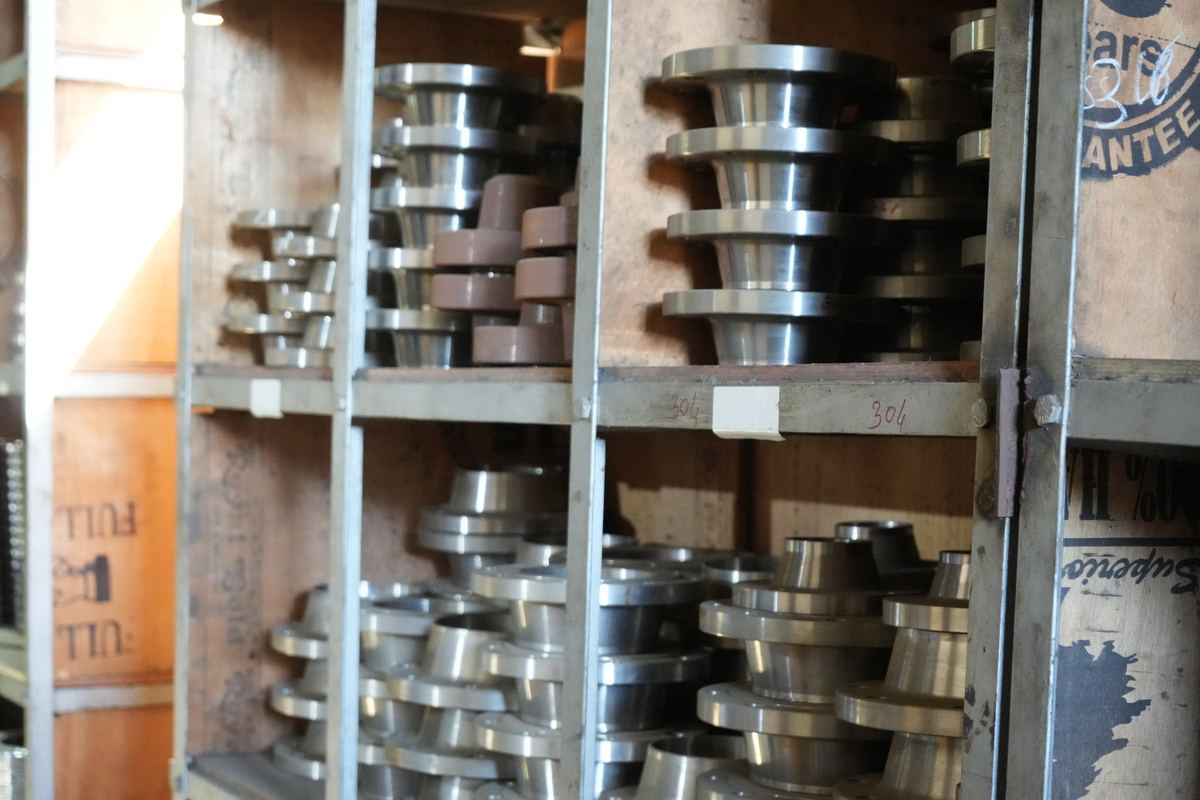
A weld neck flange has a long tapered hub that is butt welded to the pipe. It gives the strongest joint and a smooth, crevice-free bore, which is why it is the first choice on stainless secondary loops and at pump and CDU connections.
Specify weld neck flanges where the joint must be strong, fully inspectable and clean inside: stainless TCS headers, CDU nozzles, and pump and chiller connections that see vibration and thermal cycling.
How a weld neck works
The tapered hub spreads bending stress from the flange ring into the pipe wall, and the butt weld between hub and pipe is a full-penetration joint that can be radiographed or ultrasonically tested. The bore of the hub matches the pipe, so the inside of the line is continuous with no step and no crevice.
Why it suits clean loops
The Open Compute Project's guidance for TCS row manifolds calls for stainless pipe welded to AWS D10.18 under an inert gas purge, which avoids heat tint inside the pipe. A weld neck butt weld fits that procedure exactly. A slip-on flange, by contrast, has an internal fillet weld that is hard to purge and leaves a crevice where particles and stagnant coolant can sit.
Stainless cooling pipe is often Sch 10S or Sch 40S. Order the weld neck bore to the same schedule so the weld bevel meets the pipe without a step, which would disturb flow and trap debris.
Where weld necks go in a data center
| Location | Typical spec |
|---|---|
| TCS row and rack manifold headers | 316L, Class 150 RF, pickled and passivated |
| CDU primary and secondary nozzles | 316L or 304L, Class 150 RF or PN16 |
| Pump suction and discharge | A105 or stainless, FF where the pump casing is cast iron |
| Chiller evaporator and condenser connections | A105, Class 150, face to match the chiller |
| Large headers above 24 in | ASME B16.47 Series A or B |
Frequently asked questions
Why do TCS specifications prefer weld neck flanges?
A weld neck is joined to the pipe by a single butt weld with a smooth, continuous bore. There is no internal fillet weld and no crevice where particles or stagnant coolant can collect, and the weld can be fully inspected.
What bore should we order?
The bore must match the inside diameter of your pipe. State the pipe schedule, for example Sch 10S for thin-wall stainless or STD for carbon steel, so the weld bevel lines up without a step.
Can the weld bevel be prepared for orbital welding?
Tell us the end preparation your welding procedure needs. A standard bevel is supplied unless the order states otherwise.