
Applications
Flanges for the technology cooling system
The technology cooling system, or secondary fluid network, carries coolant from the CDU to the rack manifolds and cold plates. It is the cleanest loop in the building, and every wetted part, flanges included, has to be stainless or another approved material.
TCS flanges should be 316L (304L at minimum) weld neck or lap joint flanges, Class 150 or PN16, pickled and passivated to ASTM A380 and A967, with 100% PMI and a heat-traceable EN 10204 3.1 certificate.
Why the TCS is different
Direct-to-chip liquid cooling pushes coolant through cold plates mounted on the processors. Their microchannels are about 100 µm wide. Particles, corrosion products or biological growth can block them and overheat the chip. The TCS is therefore built and commissioned like a clean process system, separated from the facility water by the CDU's heat exchanger.
The Open Compute Project's guidance on pre-commissioning TCS row manifolds sets out what that means for the piping:
| Topic | Guidance |
|---|---|
| Material | Stainless steel, minimum grade 304 |
| Surface condition on arrival | Internal surfaces treated to ASTM A380 (scale, oil and grease removed; pickled) |
| Welding | AWS D10.18 under inert gas to limit heat tint, avoiding on-site pickling |
| Pressure test | 1.3 to 1.5 times working pressure |
| Flushing velocity | 3 to 5 ft/s (about 1 to 1.5 m/s) |
| Filtration | 50 to 100 µm first stage; 5 µm final recommended |
| Procedure water | Conductivity 50 µS/cm max; pH 6 min; bacteria 1,000 CFU/ml max |
What this means for flanges
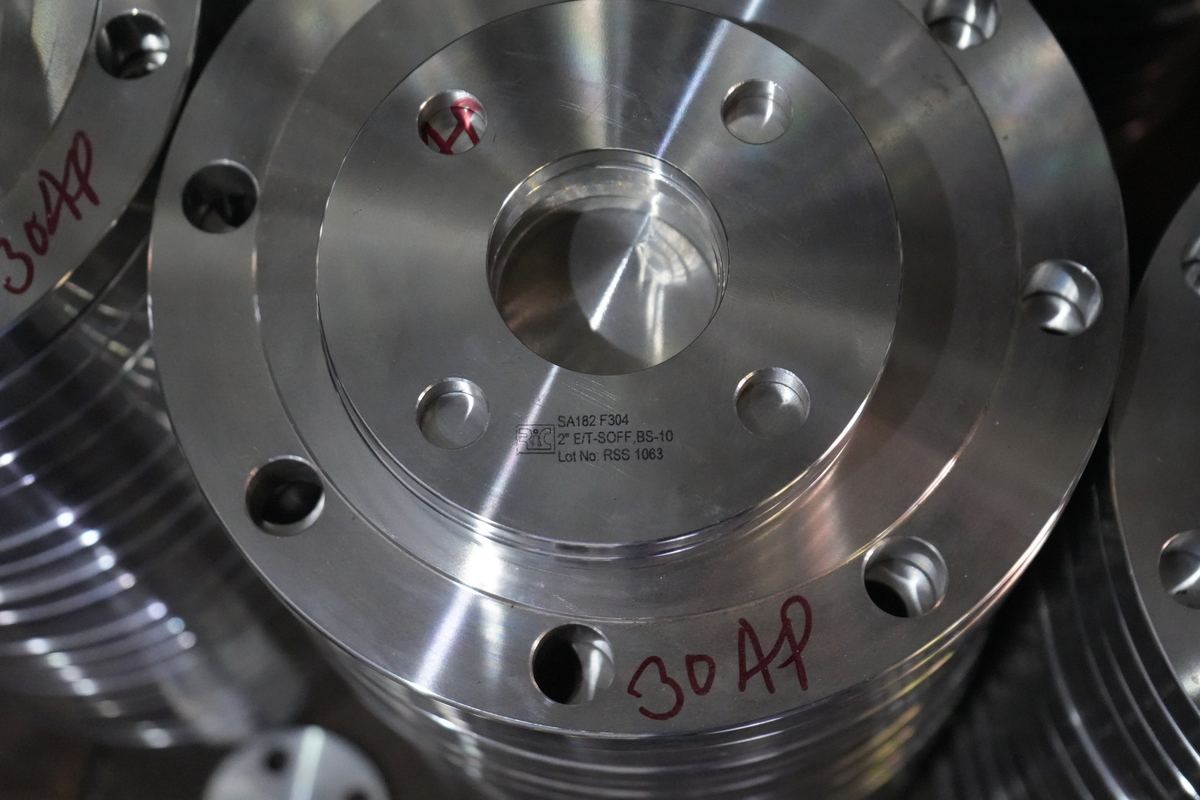
- Material: forged ASTM A182 F316L or F304L, the same grade as the pipe.
- Joint type: weld neck or stub end with lap joint flange, so the bore is butt welded and free of crevices. Avoid slip-on flanges and their internal fillet welds.
- Surface: pickled and passivated to ASTM A380 and A967, recorded on the certificate. Why it matters.
- Verification: 100% PMI so no carbon steel or wrong grade slips into the loop; IGC testing to ASTM A262 Practice E on request.
- Blinds and test points: 316L blind flanges for flushing connections and future racks, never carbon steel.
Gaskets are wetted parts too. Check the gasket elastomer or PTFE grade against the coolant supplier's approved materials list before installation.
Commissioning
Clean flanges are only the start. The loop is hydro tested, cleaned, flushed until the water is clear and its conductivity is close to the procedure water, then filled with coolant or laid up dry under nitrogen. Our TCS flushing and cleaning guide walks through each stage.
Frequently asked questions
What material does the Open Compute Project recommend for TCS piping?
Stainless steel, minimum grade 304, with internal surfaces treated to ASTM A380 before the pipe arrives on site. Many projects specify 316L.
How clean does the TCS need to be?
Clean enough for cold plates with flow channels of about 100 microns. The OCP pre-commissioning guide recommends final filtration of 5 microns, flushing at 3 to 5 ft/s, and flushing until conductivity is close to the procedure water value, with procedure water at 50 µS/cm or less.
Can slip-on flanges be used on the TCS?
They are best avoided. The internal fillet weld forms a crevice that is hard to purge and clean. Weld neck flanges or stub ends with lap joint flanges give a smooth, butt-welded bore.