
Applications
Flanges for condenser water and cooling towers
Condenser water carries heat from the chillers to cooling towers or dry coolers. The mains are large, the pressures are low, and much of the equipment it connects to has flat-faced cast iron or fibreglass flanges.
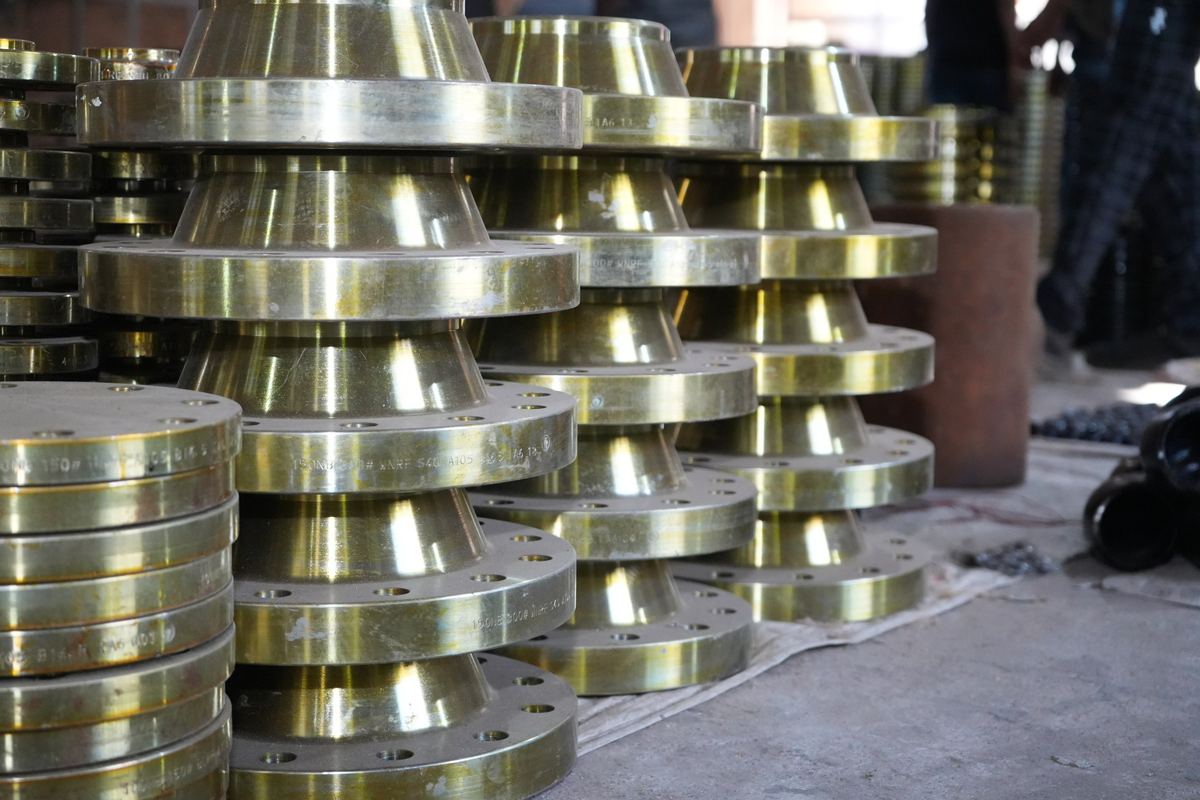
Condenser water flanges for a data center are usually carbon steel A105 at Class 150 or AWWA C207 Class D, flat faced where they meet cast iron pumps, fibreglass cooling tower connections or waterworks valves.
Open loops and closed loops
A cooling tower loop is open: water evaporates, make-up water is added, and the water is treated against scale, corrosion and biological growth. A dry cooler loop is closed and often runs a glycol mix so it does not freeze. Both connect to the chiller condensers or to heat exchangers in water-side economiser systems.
| Loop | Fluid | Flange notes |
|---|---|---|
| Open cooling tower | Treated water | A105, AWWA C207 on large mains, FF to tower and cast iron pumps |
| Closed dry cooler | Water and glycol | A105, or A350 LF2 where the metal can drop below freezing |
| Water-side economiser | Condenser water to plate heat exchanger | Match the heat exchanger nozzles, often flat faced |
Large mains
Central plants serving a hyperscale campus run condenser water mains above 24 inches. Much of that large-diameter water piping follows waterworks standards rather than ASME process standards, which is why AWWA C207 Class D ring flanges are common here. Where the project is ASME throughout, use ASME B16.47.
Fibreglass and plastic tower connections, like cast iron, need flat face steel flanges, full-face gaskets and controlled bolt torque. Follow the tower maker's torque values. More on flat face flanges.
Frequently asked questions
Which flanges suit cooling tower piping?
Carbon steel A105 Class 150 for steel piping, with flat face flanges and full-face gaskets wherever the tower, pump or valve has a cast iron, fibreglass or plastic flange. Large mains often use AWWA C207 Class D.
When is A350 LF2 needed on heat rejection piping?
When the metal can see sub-zero temperatures, for example glycol loops to roof-mounted dry coolers in cold climates. A350 LF2 Class 1 is impact tested at -46 °C.