
Flanges by material
Carbon steel flanges for data center water systems
Forged A105 and low-temperature A350 LF2 flanges, plus A36 and A516 Grade 70 plate flanges, for the facility side of a data center: condenser water, chilled water plant and the mains that feed the CDUs.
On the facility side of a data center, the default is a forged ASTM A105 flange to ASME B16.5 Class 150, weld neck or slip-on, raised face. Switch to flat face against cast iron chillers and pumps, to A350 LF2 where the pipe can freeze, and to plate or AWWA flanges on very large mains.
Where carbon steel belongs in a data center
Carbon steel is the economical material for water that does not touch IT equipment. Closed chilled water loops are dosed with corrosion inhibitors and keep their oxygen low, and condenser water is treated at the cooling tower. Hydronic piping in these systems is commonly built to ASME B31.9, Building Services Piping, which covers non-flammable liquids up to 350 psig and 121 °C (250 °F).
| System | Carbon steel? | Notes |
|---|---|---|
| Condenser water, cooling towers | Yes | Open loop with water treatment; flat face at cast iron pumps |
| Chilled water plant and headers | Yes | Closed loop; Class 150 covers most plants |
| Facility water to CDUs | Usually | Some projects run stainless from the header to the CDU |
| Technology cooling system | No | Stainless steel or copper alloys only |
A105 and A350 LF2
ASTM A105 is the standard forged carbon steel for flanges at ambient and elevated temperatures. ASTM A350 LF2 is the low-temperature version. Its Class 1 is Charpy impact tested at -46 °C (-50 °F), which makes it the right choice where piping sees sub-zero metal temperatures, such as glycol loops to dry coolers on the roof in a cold climate.
| Property | A105 | A350 LF2 Class 1 |
|---|---|---|
| Carbon, max | 0.35% | 0.30% |
| Manganese | 0.60 to 1.05% | 0.60 to 1.35% |
| Tensile strength | 485 MPa (70 ksi) min | 485 to 655 MPa (70 to 95 ksi) |
| Yield strength | 250 MPa (36 ksi) min | 250 MPa (36 ksi) min |
| Hardness | 197 HBW max | 197 HBW max |
| Impact test | Not required | Charpy at -46 °C (-50 °F) |
Both grades sit in ASME B16.5 material group 1.1. At -29 to 38 °C a Class 150 flange is rated 19.6 bar (285 psi) and a Class 300 flange 51.1 bar (740 psi), more than enough for most data center water plants. Tall buildings can push the lowest floors to Class 300 once static head is added to pump head.
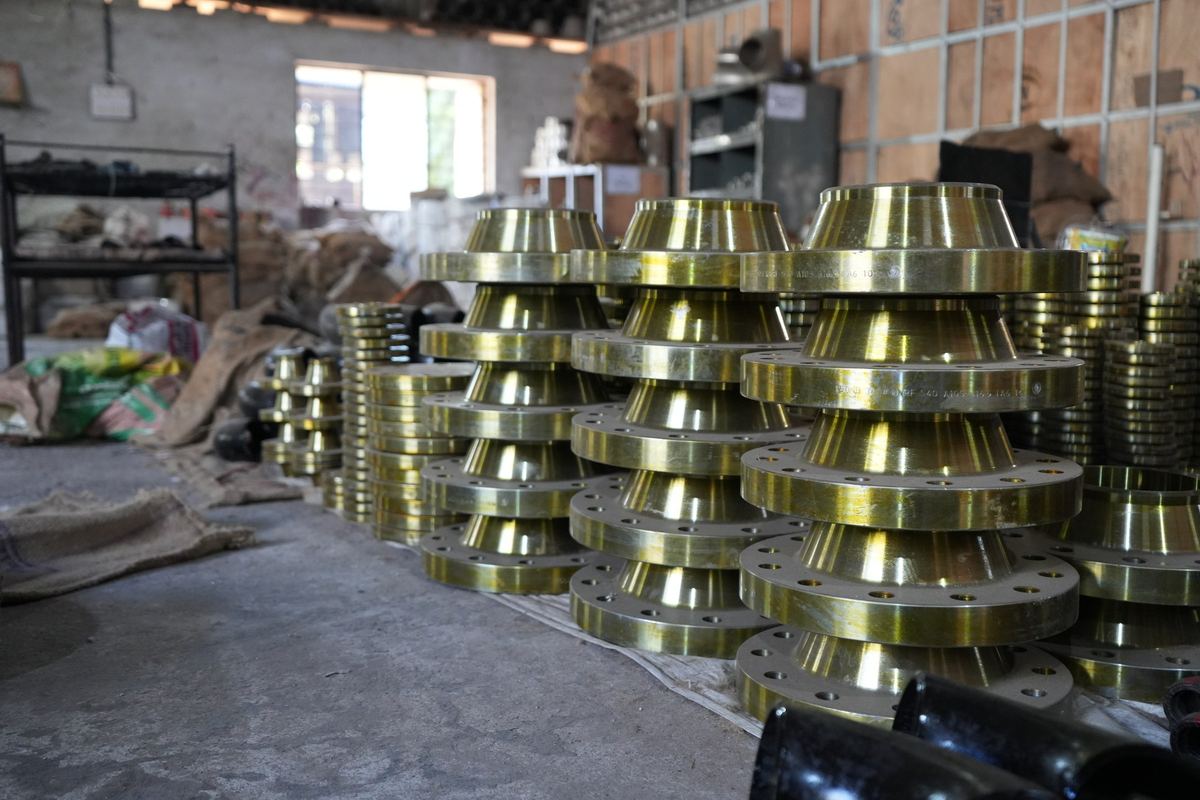
Plate flanges for large mains
Above 24 inches, many water projects use plate flanges cut and machined from steel plate instead of forgings. We make plate flanges in ASTM A36, A516 Grade 70 and IS 2062. Ring flanges of this kind are the usual construction for AWWA C207 on large condenser and chilled water mains. Where the project calls for ASME dimensions above 24 inches, see ASME B16.47 large diameter flanges.
Faces and mating equipment
Raised face is standard for steel-to-steel joints. Chillers, pumps, strainers and valves in the plant room often have cast iron flanges to ASME B16.1 Class 125, which are flat faced. Bolt a flat face steel flange with a full-face gasket to them. A raised face tightened against cast iron can crack the casting. Read the flat face guide.
Where a carbon steel facility water main meets a stainless CDU connection, the water can drive galvanic corrosion of the carbon steel. Many specifications call for an insulating gasket kit at that joint. How flange isolation kits work.
Marking, testing and certificates
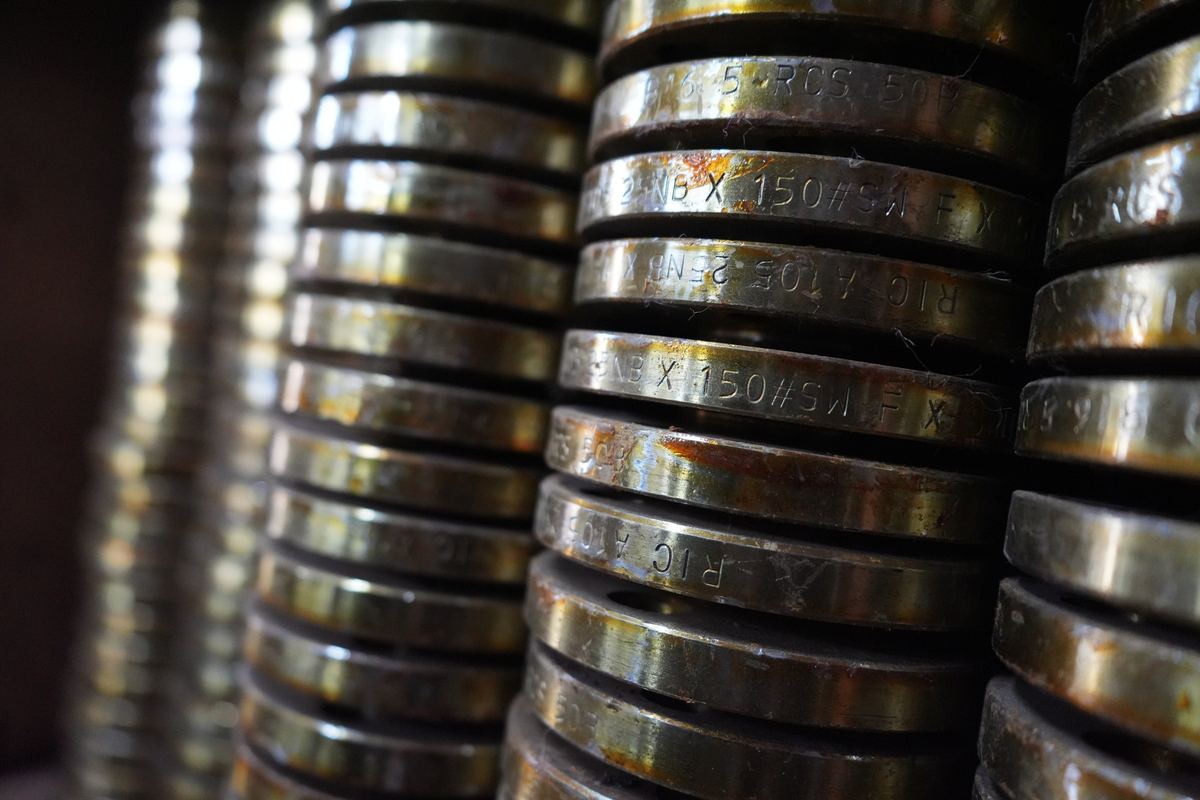
Each carbon steel flange is stamped with RIC, specification, grade, size, class and lot number. Mechanical tests are run on our 400 kN universal testing machine and hardness on a Rockwell cum Brinell tester, with lot samples also checked by NABL-accredited laboratories. Results, chemistry and heat treatment are reported on an EN 10204 3.1 certificate.
Frequently asked questions
Can carbon steel flanges be used on the technology cooling system?
No. Carbon steel corrodes in water and releases iron oxide particles that can block cold plate channels of about 100 microns. Cooling guidelines from IBM and the Open Compute Project restrict the secondary loop to stainless steel and copper alloys. Use carbon steel on the facility side only.
When should we specify A350 LF2 instead of A105?
When the metal can get cold. A350 LF2 Class 1 is Charpy impact tested at -46 °C (-50 °F), so it is the safer choice for glycol loops to outdoor dry coolers and for plant in cold climates. A105 has no impact test requirement.
What finish do carbon steel flanges ship with?
Our standard finish is a yellow rust-preventive coating, which protects the flange in storage and transit. Clean it off the weld bevel and the gasket face before installation. Tell us if your specification calls for a different protective finish.
Do carbon steel and cast iron flanges bolt together?
Yes, ASME B16.5 Class 150 steel flanges share bolt circles and bolt sizes with ASME B16.1 Class 125 cast iron flanges up to 24 inches. Use a flat face steel flange and a full-face gasket against cast iron, never a raised face.