
Flanges by material
Stainless steel flanges for data center cooling
Stainless steel flanges in 304, 304L, 316 and 316L for coolant distribution units, technology cooling loops and stainless facility water mains. Forged to ASTM A182, solution annealed, and pickled and passivated when your loop needs it.
For data center cooling, specify 316L or 304L forged flanges to ASTM A182, ASME B16.5 Class 150, weld neck or slip-on, pickled and passivated. That combination covers almost every stainless joint between the CDU and the rack manifold.
Why the loop decides the material
A liquid-cooled data center runs two water circuits. The facility water system carries heat from the CDUs to the chillers or dry coolers and is often carbon steel. The technology cooling system (TCS) carries treated coolant, usually water or a propylene glycol mix such as PG25, through the server cold plates. Their flow channels are about 100 microns wide, so any rust or scale released into the TCS ends up as a blockage.
That is why cooling designers restrict wetted metals on the secondary loop. IBM's water-cooling specification limits wetted metals to copper alloys and stainless steel and rules out plain carbon steel, because it rusts and fouls the loop. The Open Compute Project pre-commissioning guide for TCS row manifolds sets stainless steel of at least grade 304 as the pipework material. Stainless flanges on that loop have to match the pipe, and they have to arrive clean.
304L or 316L
Both grades are austenitic stainless steels with about 18% chromium. The difference is molybdenum. 316L contains 2 to 3% molybdenum, which improves resistance to pitting and crevice corrosion when chlorides are present, for example from make-up water or a leaking heat exchanger. In a sealed, inhibited TCS loop either grade works. Specify 316L where the project wants a margin against chlorides, which is the more common choice on hyperscale secondary loops.
| Grade | UNS | C | Cr | Ni | Mo | Typical data center use |
|---|---|---|---|---|---|---|
| F304 | S30400 | 0.08 | 18.0 to 20.0 | 8.0 to 11.0 | - | Stainless mains where welding is limited |
| F304L | S30403 | 0.030 | 18.0 to 20.0 | 8.0 to 12.0 | - | Stainless facility water, TCS (minimum grade) |
| F316 | S31600 | 0.08 | 16.0 to 18.0 | 10.0 to 14.0 | 2.00 to 3.00 | CDU skids, threaded or bolted assemblies |
| F316L | S31603 | 0.030 | 16.0 to 18.0 | 10.0 to 15.0 | 2.00 to 3.00 | TCS and CDU secondary side, the usual choice |
| Grade | Tensile strength | Yield strength (0.2%) | Elongation | Reduction of area |
|---|---|---|---|---|
| F304, F316 | 515 MPa (75 ksi) | 205 MPa (30 ksi) | 30% | 50% |
| F304L, F316L | 485 MPa (70 ksi) | 170 MPa (25 ksi) | 30% | 50% |
Low carbon matters because almost every flange in a cooling system is welded. With carbon held to 0.030%, chromium carbides do not form along grain boundaries in the heat-affected zone, so the weld keeps its corrosion resistance without heat treatment after welding.
Pressure ratings at cooling loop temperatures
Data center water loops run cool, well inside the ambient row of the ASME B16.5 rating tables. The low carbon grades are rated slightly lower than 304 and 316 because of their lower yield strength.
| Material group | Grades | Class 150 | Class 300 |
|---|---|---|---|
| 2.1 | F304 | 19.0 bar (275 psi) | 49.6 bar (720 psi) |
| 2.2 | F316 | 19.0 bar (275 psi) | 49.6 bar (720 psi) |
| 2.3 | F304L, F316L | 15.9 bar (230 psi) | 41.4 bar (600 psi) |
Class 150 in 316L still gives 15.9 bar, which is well above the operating pressure of a TCS loop. Check the rating at your design temperature if the loop runs warm water, for example the W40 or W45 classes in ASHRAE's liquid cooling guidelines.
Delivered clean: annealing, pickling and passivation
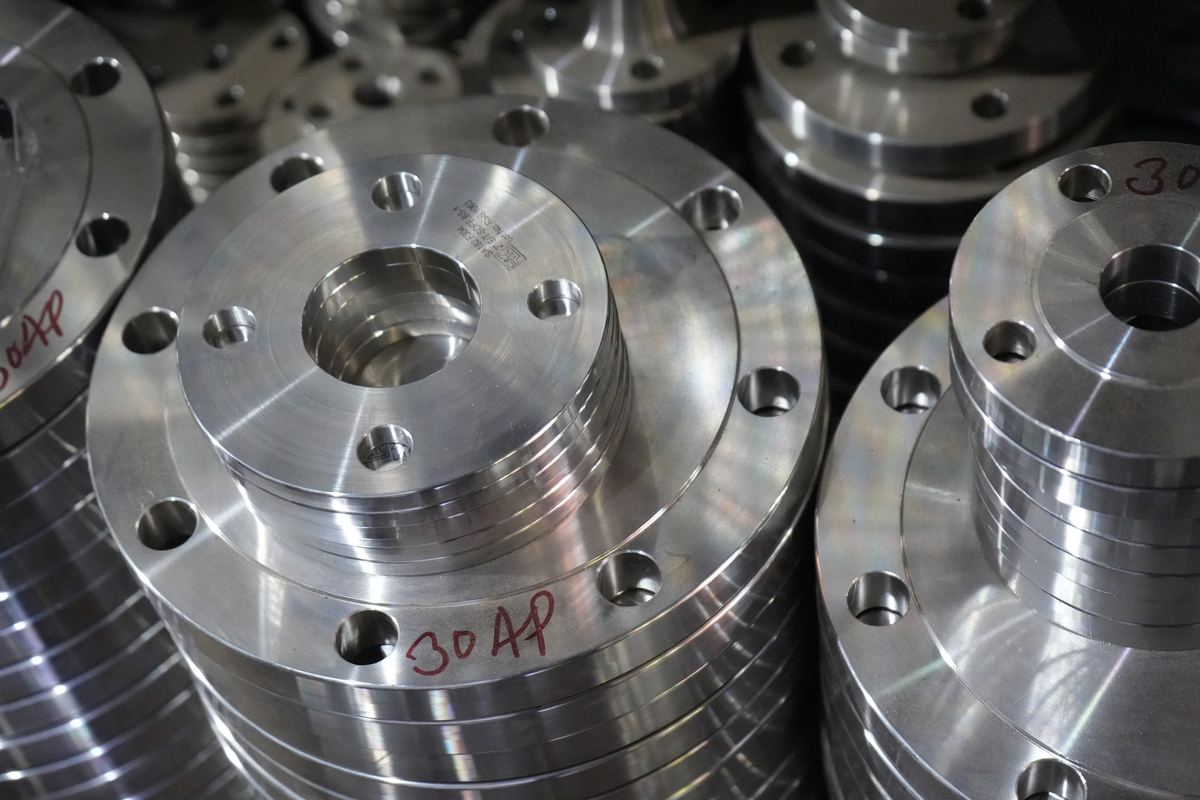
Every stainless forging is solution annealed. Our sample certificate for F316L records solution annealing at 1060 °C followed by water quenching, which dissolves carbides and restores full corrosion resistance after forging.
For TCS and CDU work we supply flanges pickled and passivated to ASTM A380 and ASTM A967. Pickling removes scale, heat tint and embedded iron. Passivation dissolves free iron from the surface and lets the chromium oxide film reform. The OCP guide expects TCS piping to arrive on site with internal surfaces already treated to ASTM A380, so flanges treated this way go straight into the clean build. Read how pickling and passivation work.
Put "pickled and passivated to ASTM A380/A967" on the line item. We record the treatment on the EN 10204 3.1 certificate, so your QA team can check it at goods receipt.
Testing and traceability
- Positive material identification: every stainless flange is checked on our Bruker PMI analyser, and the result is recorded on the certificate as 100% PMI.
- Intergranular corrosion: ASTM A262 Practice E testing on request, the copper-copper sulfate-sulfuric acid bend test for sensitization.
- Mechanical tests: tensile tests on our 400 kN universal testing machine and hardness on a Rockwell cum Brinell tester, with samples from each lot also sent to NABL-accredited laboratories.
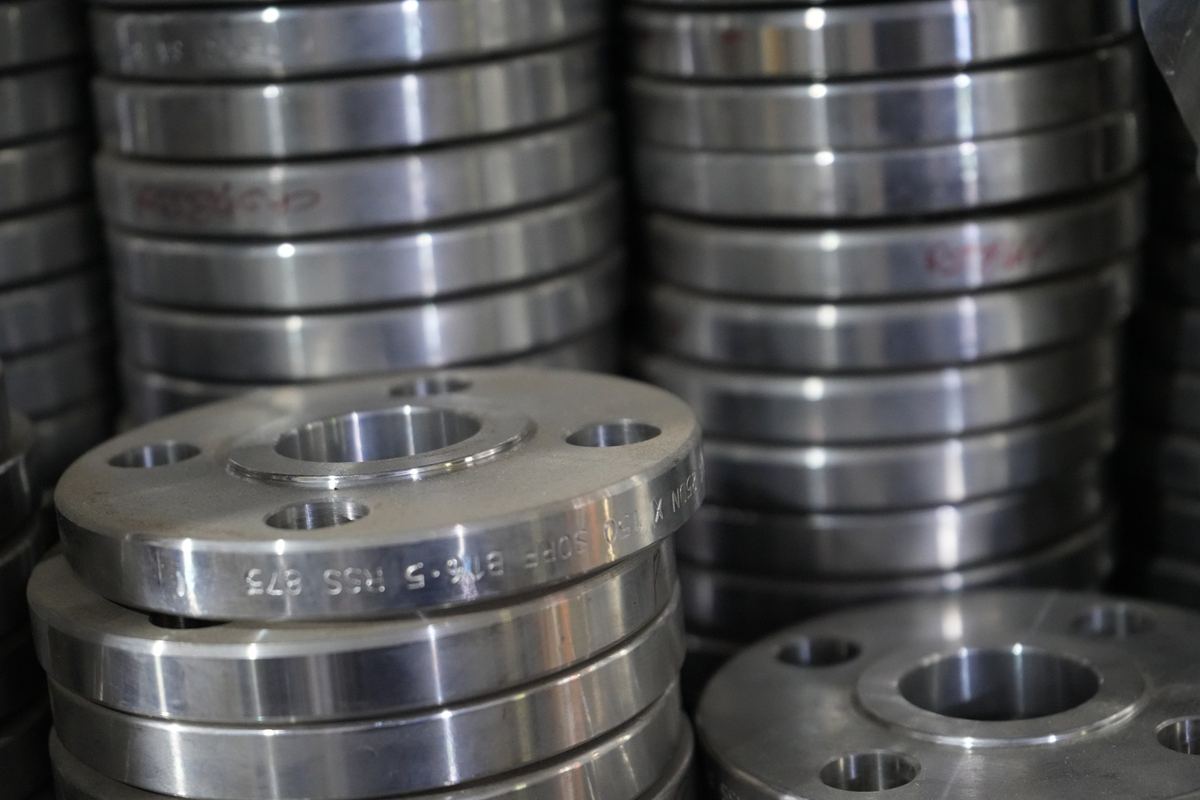
- Marking: each flange is stamped RIC, specification, grade, size and lot number, which matches the lot number on the certificate.
See a worked example in how to read our EN 10204 3.1 certificate.
Flange types we make in stainless
| Type | Where it fits |
|---|---|
| Weld neck | Butt-welded joints on TCS headers, CDU nozzles and pump connections; full-penetration weld, smooth bore |
| Slip-on | Lower cost joints on stainless mains where the specification allows fillet welds |
| Lap joint with stub end | Only the 316L stub end is wetted; the loose flange rotates for easy bolt alignment on skids |
| Blind | Header ends, future connections and test points for flushing and hydrostatic testing |
| Socket weld and threaded | Small bore vents, drains and instrument connections |
Frequently asked questions
Is 304L good enough for a TCS loop, or do we need 316L?
Both are used. The Open Compute Project guidance sets grade 304 as the minimum for TCS pipework. 316L adds 2 to 3% molybdenum, which raises pitting resistance if chlorides get into the water, so many hyperscale specifications call for 316L on the secondary loop and accept 304L on stainless facility water mains. Follow your project specification; we supply both.
Can you supply stainless flanges pickled and passivated?
Yes. We supply stainless flanges pickled and passivated to ASTM A380 and ASTM A967 when the order calls for it. State it on the purchase order so it is recorded on the inspection certificate.
Why choose a low carbon "L" grade?
The L grades limit carbon to 0.030%. Less carbon means less chromium carbide forms in the weld heat-affected zone, so the joint keeps its corrosion resistance without post-weld heat treatment. Since nearly every data center flange is welded to pipe, 304L and 316L are the usual choices.
Can a stainless system use carbon steel backing flanges?
Yes, with lap joint flanges. A 316L stub end carries the coolant and a lap joint flange behind it provides the bolting, so only the stub end touches the water. We make both parts.