
Guide
Pickling and passivation of stainless steel flanges
Stainless steel resists corrosion because of a chromium oxide film a few nanometres thick. Forging, machining, welding and handling disturb that film. Pickling and passivation restore it, and on a data center technology cooling loop they are part of the specification.
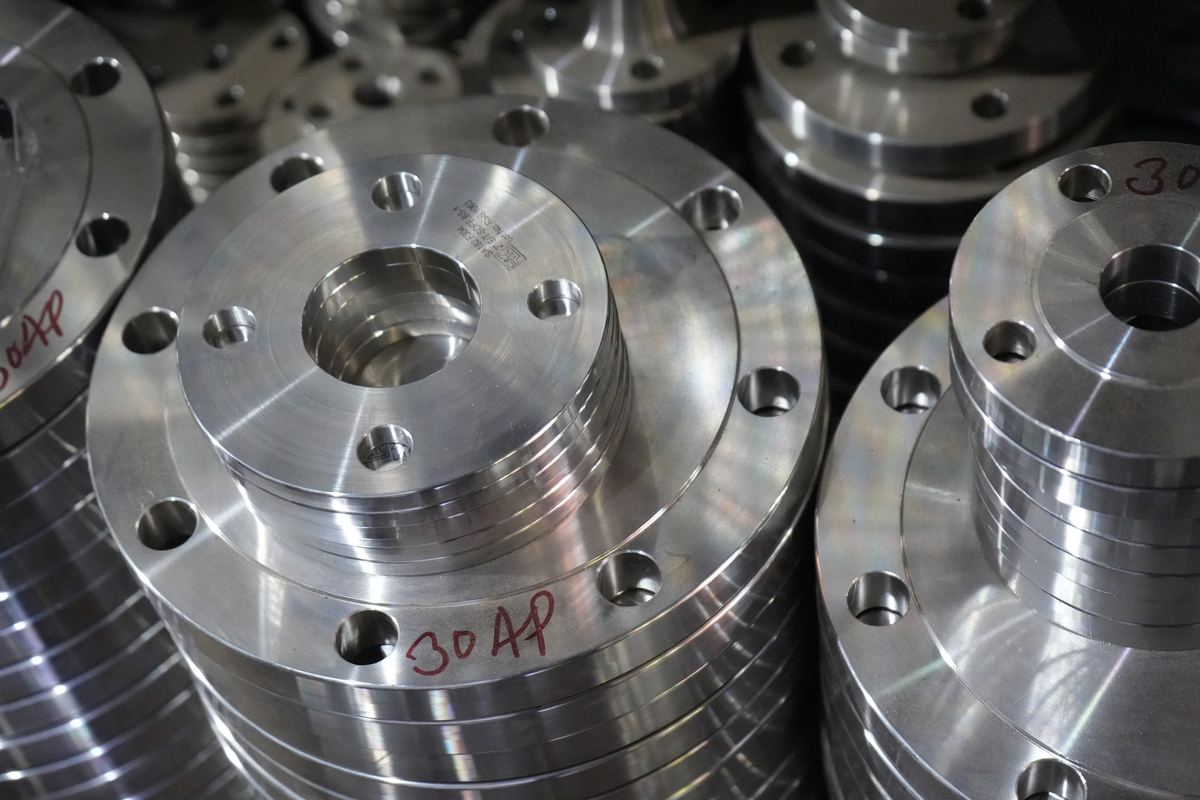
For TCS and CDU work, specify stainless flanges "pickled and passivated to ASTM A380, passivation to ASTM A967". Pickling removes scale and heat tint; passivation removes free iron so the chromium oxide film can reform. RIC supplies stainless flanges treated this way when ordered.
Why surfaces matter on a cooling loop
Free iron picked up from tools, slings or carbon steel dust rusts quickly in water and can start pitting. Heat tint from welding marks a layer depleted of chromium, with lower corrosion resistance. Either can release particles into the coolant, and the cold plates at the end of the TCS have channels about 100 microns wide. The Open Compute Project's guide for TCS row manifolds therefore expects piping to arrive with internal surfaces treated to ASTM A380.
Two treatments, two standards
| Pickling | Passivation | |
|---|---|---|
| Removes | Mill scale, heat tint, chromium-depleted layer | Free iron and surface contamination |
| Typical chemistry | Nitric-hydrofluoric acid, as bath, paste or spray | Nitric acid or citric acid |
| Changes the surface | Removes a thin layer of metal | No measurable metal removal |
| Standard | ASTM A380 (cleaning, descaling and passivation practice) | ASTM A967 (chemical passivation treatments); also covered in A380 |
| When needed | After forging, heat treatment or welding | After machining and handling; after pickling |
ASTM A380 is a practice covering the cleaning, descaling and passivation of stainless parts, equipment and systems. ASTM A967 is a specification for chemical passivation treatments, with nitric and citric acid options and a choice of verification tests. Most specifications call up both.
Use wording such as: "Pickled and passivated to ASTM A380; passivation per ASTM A967". Add the verification test if your specification requires one. We record the treatment on the EN 10204 3.1 certificate.
After the flanges arrive
- Keep stainless flanges away from carbon steel: separate racks, nylon slings, stainless or dedicated tools.
- Leave protection on until fit-up, and handle the gasket face and bore with clean gloves.
- Weld with an inert gas purge to AWS D10.18 so the inside of the joint is not heat tinted. The OCP guide notes this avoids pickling on site.
- Where heat tint does occur, clean it with a stainless-only method and re-passivate.
Frequently asked questions
Is passivation the same as pickling?
No. Pickling removes scale, heat tint and the chromium-depleted layer under it, usually with nitric-hydrofluoric acid. Passivation removes free iron and other contamination from a clean surface, usually with nitric or citric acid, so the chromium oxide film can reform. Fabricated parts with heat tint need pickling first.
Do stainless flanges need passivating if they are already stainless?
Machining, handling and storage can leave free iron on the surface, which rusts and can start pitting. For a clean TCS loop, flanges should be passivated after machining, and pickled where there is scale or heat tint.
How is passivation verified?
ASTM A967 lists verification tests such as water immersion, high humidity, salt spray, copper sulfate and potassium ferricyanide tests. The purchaser chooses the test on the order.