
Flange identifier
A flange without a readable stamp can still be identified: four measurements with a tape and a caliper are enough to find its standard, size and class.
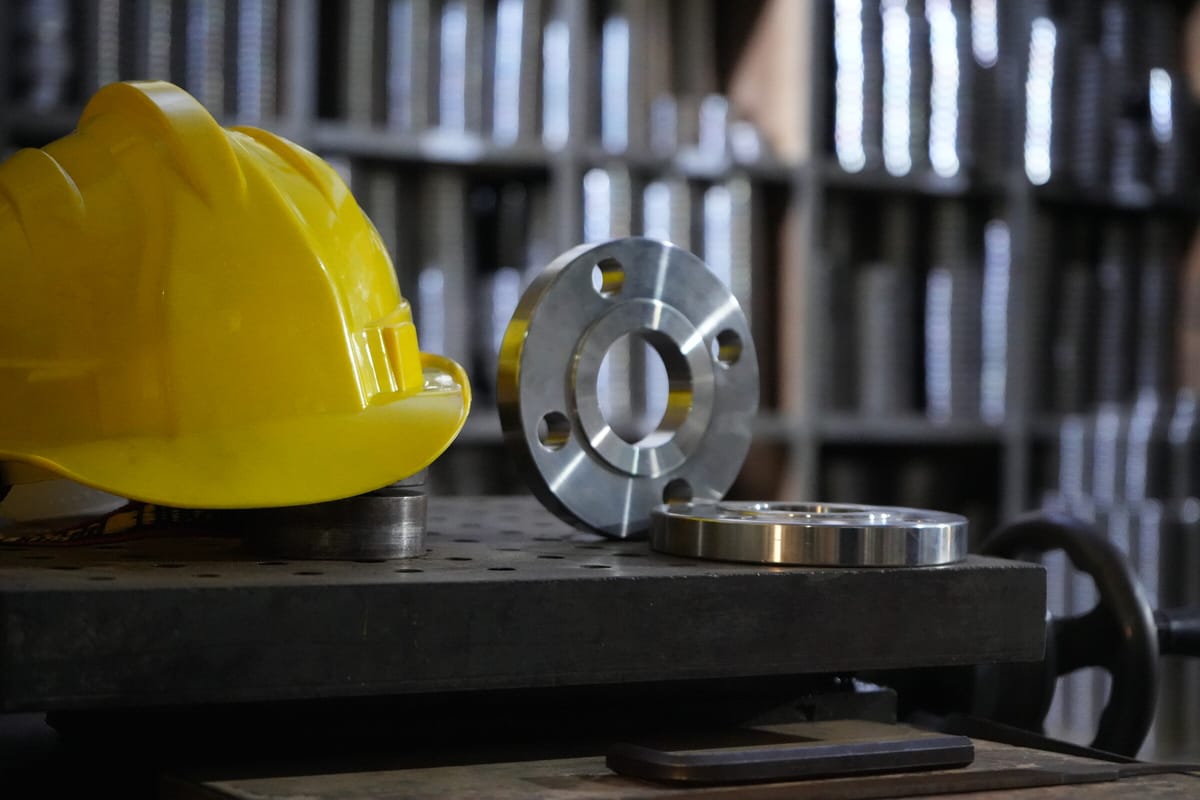
An unmarked flange can be identified from four measurements: the outside diameter, the bolt circle (the diameter through the centres of the bolt holes), the number of bolt holes and their diameter. Enter them below; the identifier lists the ASME B16.5 and EN 1092-1 flanges that match, closest first, each with its drawing. A fifth measurement, the height of the raised face, tells Class 300 from Class 600 in the small sizes where they are drilled alike.
Identify a flange
Enter at least the outside diameter or the bolt circle. Decimals with a point or a comma both work.
How to measure
- Outside diameter. Across the flange at its widest, through the centre. Two or three readings in different directions, averaged, take care of a rim that is not quite round.
- Bolt circle. With an even number of holes, measure from the centre of one hole to the centre of the hole opposite. Easier with a tape: from the left edge of one hole to the left edge of the hole opposite gives the same figure. With four holes, the centre distance between two neighbouring holes times 1.414 is the bolt circle.
- Bolt holes. Count them, and measure one across with a caliper. The hole is usually 1/8 in (3 mm) larger than the bolt.
- Raised face height. From the flange face outside the gasket area to the top of the raised face, with a depth gauge or the end of a caliper. ASME B16.5 Class 150 and 300 flanges have a 1/16 in (1.6 mm) raised face and Class 400 and above 1/4 in (6.4 mm); EN 1092-1 raised faces are 2 to 5 mm, by size. Enter 0 for a flat face, and leave it empty for a ring type joint.
- Type you can see: a hub (weld neck or slip-on), a plain plate, or a loose ring behind a stub end (lap joint). It does not change the drilling, so the identifier does not ask for it.
If the stamp on the rim is still readable, it names the flange without measuring; our guide to flange markings explains each mark.
When the result shows more than one rating
Some ratings are drilled alike. In ASME B16.5, Class 300, 400 and 600 flanges have the same outside diameter and drilling from NPS 1/2 to 3, and Class 900 and 1500 from NPS 1/2 to 2-1/2. Class 300 is thinner, with a 1/16 in (1.6 mm) raised face; Class 400 and 600 have identical dimensions with a 1/4 in (6.4 mm) raised face, as do Class 900 and 1500. In EN 1092-1, PN 10, 16, 25 and 40 share the outside diameter and drilling from DN 15 to DN 80 (PN 25 and 40 are thicker from DN 50), PN 10 and 16 stay alike up to DN 150, as do PN 25 and 40, and PN 63 and 100 are alike from DN 15 to DN 40.
A flange drilled like another bolts to it, but its pressure rating is not the same. The rating a replacement needs comes from the line's design pressure and temperature, named in the piping specification or the line list; the stamp on the old flange and its material show what was installed. An ASME flange and an EN flange of the same nominal size are not interchangeable: their bolt circles and bolt sizes differ, as our guide to flange drawings shows for NPS 4 Class 150 and DN 100 PN 16.
After you have identified it
To order a replacement or a mating flange, add the type and face you can see, the material, and for a weld neck flange the pipe schedule, which sets the bore. Each result links to the drawing of that size and rating; the 3D model of the same flange downloads as a STEP or STL file, and the quote form takes the whole list.
Questions about identifying flanges
Can I tell Class 150 from Class 300 by eye?
Often, yes. At every size a Class 300 flange has a larger outside diameter and bolt circle and is thicker, and in most sizes it has more bolts or larger ones; NPS 1/2 and NPS 5 keep the same bolts. Measure the bolt circle and count the holes to be sure; the stamp on the rim, if it is still readable, names the class.
Why does the identifier show more than one class for a flange?
Some ratings share their outside diameter and drilling: ASME B16.5 Class 300, 400 and 600 from NPS 1/2 to 3, Class 900 and 1500 from NPS 1/2 to 2-1/2, and in EN 1092-1 PN 10, 16, 25 and 40 in the small sizes. Class 300 has a 1/16 in (1.6 mm) raised face and Class 400 and 600 a 1/4 in (6.4 mm) one, so the raised face height separates them; the other pairs have the same dimensions, and the rating comes from the stamp and the material.
Will a Class 150 steel flange bolt to a cast iron Class 125 flange?
Up to NPS 24 the bolt circle, bolt count and bolt size match ASME B16.1 Class 125. Use a flat face steel flange and a full-face gasket against cast iron.