
Data center cooling and flange glossary
The terms that turn up in data center cooling specifications and flange schedules, defined in plain words, with a link to the page that covers each one in depth.
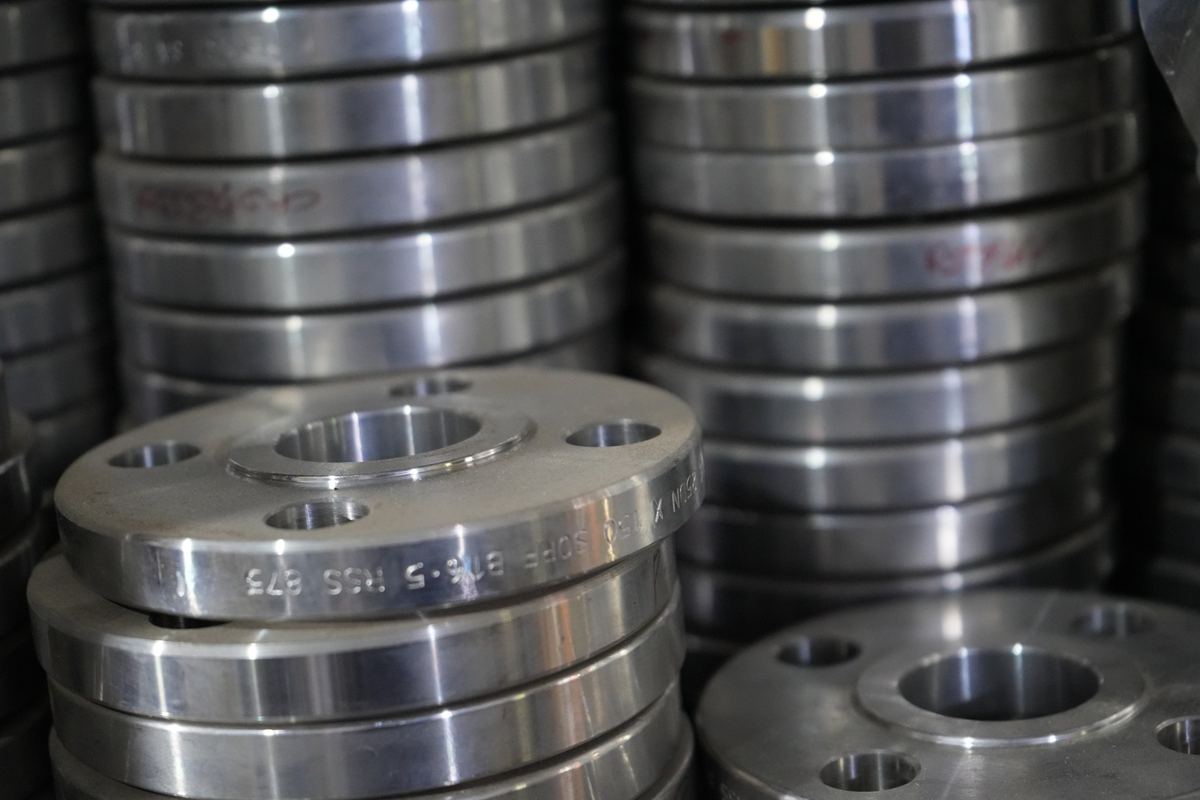
This glossary defines the cooling system terms, performance measures and flange terms used across this site, from CDU and TCS to Class 150 and EN 10204 3.1. Each definition links to the page that explains it in depth.
Cooling systems
- CDU Coolant distribution unit
- A unit with a heat exchanger, pumps, filters and controls that separates the facility water from the technology cooling loop and sets its temperature and flow. See Coolant distribution units.
- TCS Technology cooling system
- The closed, clean loop between the CDU and the IT equipment: rack manifolds, cold plates and the headers between them. ASHRAE term. See Technology cooling system (TCS).
- FWS Facility water system
- The loop that carries heat from the CDUs to the plant: chillers, dry coolers, cooling towers or heat reuse. See FWS vs TCS.
- SFN Secondary fluid network
- Another name for the technology cooling system, used by some suppliers and the Open Compute Project. See FWS vs TCS.
- DLC Direct liquid cooling
- Cooling in which liquid reaches the heat source, usually through cold plates on processors (direct-to-chip). See Direct-to-chip cooling.
- Cold plate
- A metal block on a processor with fine internal channels, often about 100 microns wide, that coolant flows through. See Direct-to-chip cooling.
- Manifold Rack or row manifold
- The pipe that shares coolant between servers in a rack or racks in a row, usually with quick disconnects at each outlet. See Technology cooling system (TCS).
- UQD Universal quick disconnect
- A quick disconnect coupling to an Open Compute Project specification, used to connect servers to rack manifolds. See Direct-to-chip cooling.
- RDHx Rear-door heat exchanger
- A water coil that replaces the rear door of a rack and cools the exhaust air. Passive doors use the server fans; active doors add their own. See Rear-door heat exchangers.
- Immersion cooling
- Servers submerged in dielectric fluid. Single-phase systems pump the liquid to a heat exchanger; two-phase systems boil it and condense it on a water-cooled coil. See Immersion cooling.
- CRAH Computer room air handler
- An air handler with a chilled water coil and fans that cools the room air. See Chilled water systems.
- CRAC Computer room air conditioner
- A room cooling unit with its own refrigeration compressor rather than a chilled water coil. See Chilled water systems.
- Dry cooler
- A fan-driven air-to-water heat exchanger that rejects heat without evaporating water. Adiabatic versions spray water to boost capacity on hot days. See Condenser water and cooling towers.
- Cooling tower
- An open evaporative heat rejection device fed by the condenser water loop. See Condenser water and cooling towers.
- W classes ASHRAE liquid cooling classes
- Facility water classes named for their maximum supply temperature: W17, W27, W32, W40, W45 and W+. See FWS vs TCS.
- PG25 Propylene glycol 25
- A water and propylene glycol mix with about 25% glycol, a common TCS coolant. See Flange gaskets.
- Free cooling
- Rejecting heat without running compressors, using cool outdoor air or water. Warmer water classes allow more hours of it. See FWS vs TCS.
- Heat reuse
- Exporting data center heat, often through heat pumps and a plate heat exchanger, to district heating or other users. See Heat reuse and district heating.
Measures
- PUE Power usage effectiveness
- Total facility energy divided by IT equipment energy. A PUE of 1.2 means 20% overhead on top of the IT load. See Heat reuse and district heating.
- WUE Water usage effectiveness
- Site water use in liters divided by IT equipment energy in kilowatt-hours. See Condenser water and cooling towers.
- ERF Energy reuse factor
- The share of a data center's energy that is reused outside it, for example as heat for a district heating network. See Heat reuse and district heating.
- Delta T Temperature difference
- The rise in coolant temperature across a load. Doubling the delta T halves the flow needed for the same heat. See Direct-to-chip cooling.
Flanges and piping
- Class 150 ASME pressure class
- A pressure-temperature rating designation in ASME B16.5 and B16.47. Not a pressure in psi. See Pressure class selection.
- PN16 Pressure nominal
- An EN 1092-1 rating designation, close to the allowable pressure in bar at room temperature for the reference material. See EN 1092-1.
- RF Raised face
- A flange face with a raised ring that concentrates gasket load. Used for steel to steel joints. See Flat face vs raised face.
- FF Flat face
- A flange face with no raised ring, used against cast iron, plastic and fiberglass with a full face gasket. See Flat face flanges.
- WN Weld neck flange
- A flange with a tapered hub that is butt welded to the pipe. The strongest common type. See Weld neck flanges.
- SO Slip-on flange
- A flange that slips over the pipe and is fillet welded inside and outside. See Slip-on flanges.
- LJ Lap joint flange
- A loose flange that sits behind a stub end, so only the stub end touches the fluid. See Lap joint and stub ends.
- Stub end
- A short pipe end with a flared lap, butt welded to the pipe and backed by a lap joint flange. See Lap joint and stub ends.
- Blind Blind flange
- A solid flange that closes a pipe end, used at header ends and future connections. See Blind flanges.
- ASME B16.5
- The standard for steel pipe flanges NPS 1/2 to 24. See ASME B16.5.
- ASME B16.47
- The standard for large diameter steel flanges, NPS 26 to 60, Series A and B. See ASME B16.47.
- AWWA C207
- The waterworks standard for steel pipe flanges, used on large water mains. See AWWA C207.
- AWWA C228
- The waterworks standard for stainless steel ring slip-on and blind flanges. See AWWA C228.
- EN 1092-1
- The European standard for steel flanges with PN designations. See EN 1092-1.
- ASME B31.9
- The building services piping code that covers most data center water piping in North America. See ASME B31.9.
- Pickling
- Acid treatment that removes scale and heat tint from stainless steel, to ASTM A380. See Pickling and passivation.
- Passivation
- Treatment that removes free iron and restores the chromium oxide layer on stainless steel, to ASTM A967 or A380. See Pickling and passivation.
- PMI Positive material identification
- A check of alloy composition, usually with a handheld analyser, to confirm the grade of each piece. See Quality and traceability.
- MTC Mill test certificate
- The inspection certificate listing chemistry, mechanical tests and heat treatment for a heat or lot. Also called a mill test report (MTR). See Reading an EN 10204 3.1 certificate.
- EN 10204 3.1 Inspection certificate type 3.1
- A certificate issued by the manufacturer's inspection department, independent of production, with actual test results. See Reading an EN 10204 3.1 certificate.
- Hydro test Hydrostatic test
- Filling a piping system with water and holding it at a pressure above design, for example 1.5 times under ASME B31.9. See ASME B31.9.
- Flushing
- Running water through a new loop at high velocity, with filters, to remove debris before the IT equipment is connected. See TCS flushing and cleaning.
- Insulating kit Flange insulating kit
- A gasket, sleeves and washers that break the electrical path between dissimilar metal flanges. See Dissimilar metal isolation.