
Rear-door heat exchangers: piping and flange connections
A rear-door heat exchanger replaces the back door of a rack with a water coil. Hot exhaust air passes through it and leaves the rack close to room temperature. The door connects with hoses, but the water behind it runs through headers and CDUs like any other cooling loop.
Each rear door connects to a supply and a return header through flexible hoses with quick couplings or threaded fittings. The headers, isolation valves, strainers and the CDU or heat exchanger that feed them are the flanged part of the system. Because the coil must stay above the room's dew point, many installations feed the doors from a CDU on a secondary loop rather than straight from chilled water.
Passive and active doors
| Type | How air crosses the coil | Where it fits |
|---|---|---|
| Passive | The servers' own fans push exhaust air through the coil; the door has no fans | Moderate rack densities, quiet and simple |
| Active | Fans in the door pull air through a deeper coil | Higher densities, or racks whose server fans cannot overcome the coil |
Rear doors cool the air that leaves the rack, so they suit air-cooled servers and the air-cooled share of heat from liquid-cooled racks. Many liquid-cooled halls use both: cold plates for the processors and rear doors for everything else in the rack.
Water temperature and condensation
A rear door sits in the room, so its coil and pipes must stay warmer than the dew point of the room air. If they do not, water condenses on the coil and the pipework. Systems prevent this by controlling the supply temperature a few degrees above the dew point, by monitoring room humidity, and by insulating cold pipework. That control is easiest with a CDU that owns the door loop.
Rear doors work with water well above traditional chilled water temperatures. That suits the warmer ASHRAE water classes and leaves more hours of free cooling at the plant. ASHRAE W classes explained.
From the door to the plant
| Component | What it does | Typical joint |
|---|---|---|
| Door coil | Water to air heat exchanger in the rack door | Hose tails, quick couplings or threaded fittings |
| Hoses | Flexible connection so the door can swing open | Quick couplings at both ends |
| Row headers | Supply and return pipes overhead or under the floor | Welded or flanged, with flanged branches and blind ends for future racks |
| Isolation valves and strainers | Isolate a row, protect the coils from debris | Flanged or lug-type valves between flanges |
| CDU or heat exchanger | Separates the door loop from chilled or facility water, pumps and controls it | Flanged nozzles on both sides |
| Chilled or facility water mains | Carry the heat to the plant | Welded, flanged or grooved, to the facility specification |
Flanges for a rear-door loop
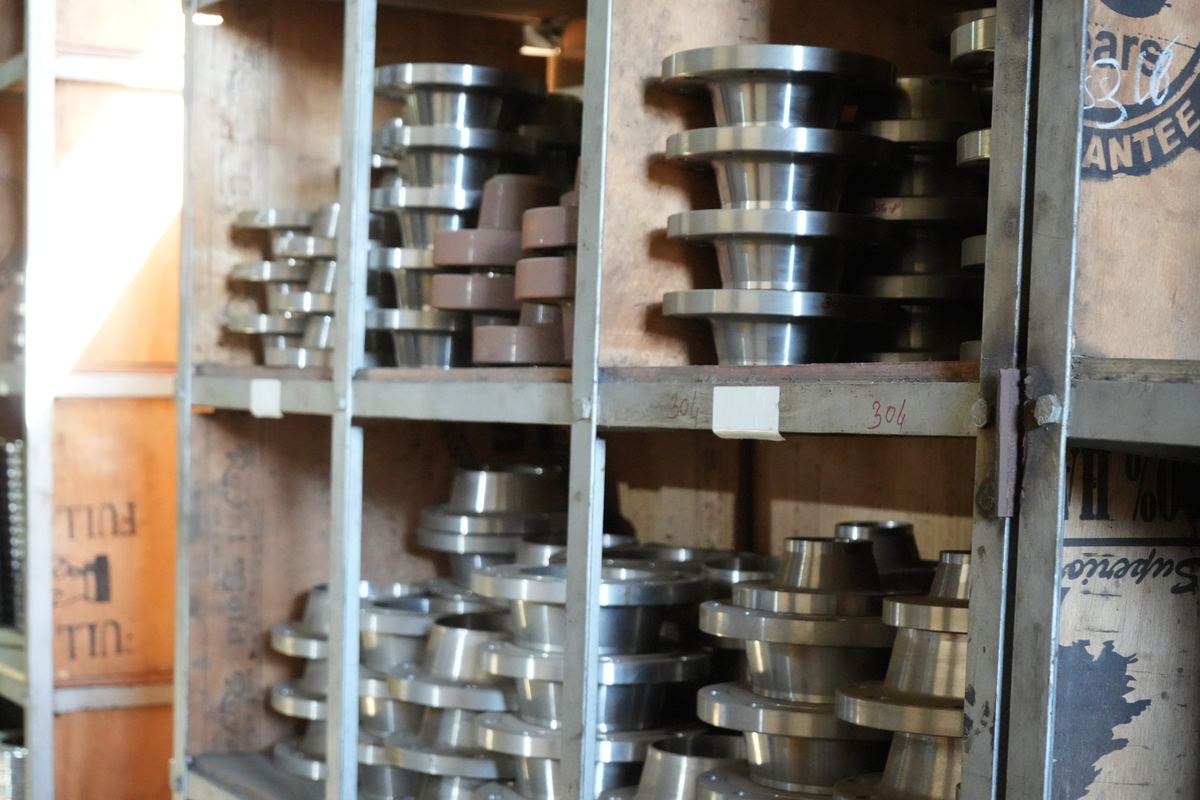
- Headers and branches: weld neck or slip-on flanges, ASME B16.5 Class 150 or EN 1092-1 PN16.
- Stainless loops: 304L or 316L, pickled and passivated when the loop is cleaned to a liquid cooling standard.
- Future racks: blind flanges on header branches, so new doors connect without draining the row.
- Gaskets: EPDM or PTFE, the same as the rest of a closed water loop. Flange gaskets for water and glycol.
Send the header schedule with sizes, class or PN, grade and quantities, and we will quote the flanges for the whole row. Request a quote.
Frequently asked questions
Can rear doors run straight off the chilled water system?
Some do, with controls that keep the coil above the room dew point. Many installations put a CDU between the chilled water and the doors instead, so the door loop has its own temperature control, pumps and filtration, and a leak cannot drain the main chilled water system.
Do rear-door heat exchanger loops need stainless steel headers?
Follow the door maker's wetted materials list. Door coils are usually copper, so the secondary loop that feeds them is often stainless steel or copper, with flanges and valves to match. Avoid mixing bare carbon steel into a closed loop that also contains copper coils without a water treatment plan.
Are rear doors connected with flanges?
The door itself usually connects with flexible hoses and quick couplings or threaded fittings. The flanges are on the headers, isolation valves and CDU connections that feed the doors.
Sources
- ASHRAE TC 9.9, Thermal Guidelines for Data Processing Environments (liquid cooling classes)
- Manufacturers' installation guidance for passive and active rear-door heat exchangers