
Choosing a flange pressure class for data center piping
Most data center water flanges are Class 150 or PN16. The exceptions come from tall buildings, high pump heads and stainless grades near their limit, and one simple sum finds them.
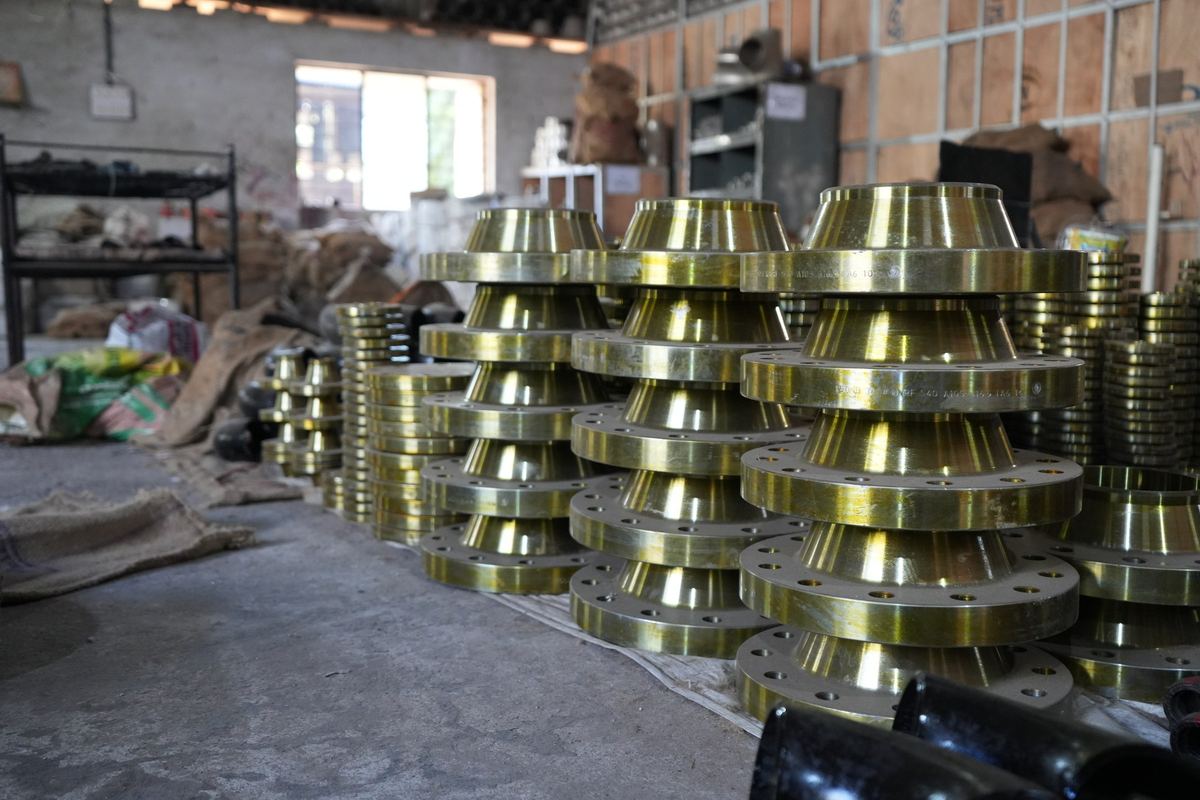
Add the static head at the lowest flange, the pump shut-off head and an allowance for surge, then compare that total, and the hydrostatic test pressure, with the flange rating at the loop's design temperature. Class 150 or PN16 covers most data center chilled water, facility water and technology cooling loops. Class 300 or PN25 is for tall buildings, high-head pump discharges and stainless grades that would otherwise run close to their rating.
What sets the pressure at a flange
| Contribution | How to estimate it | Rule of thumb |
|---|---|---|
| Static head | Height of water above the flange, from the highest point of the loop | About 0.1 bar per meter (0.433 psi per foot) |
| Fill or expansion tank pressure | Set so the highest point stays above atmospheric pressure | Often 0.5 to 1 bar at the top of the system |
| Pump head | Use the shut-off head from the pump curve, not the duty point | Highest on the pump discharge, falls along the circuit |
| Surge | Fast valve closure or a pump trip sends a pressure wave | Set by the designer; larger on long mains |
| Test pressure | The hydrostatic test the code or owner requires | ASME B31.9: 1.5 times the design pressure |
The highest pressure is usually at the lowest flange on the discharge side of the pumps. Start there.
Class 150 and Class 300 ratings
ASME B16.5 rates each class by material group and temperature. Data center loops run cool, so the ambient row of the tables applies to most of them:
| Material group | Flange grades | Class 150 | Class 300 |
|---|---|---|---|
| 1.1 | A105, A350 LF2 | 19.6 bar (285 psi) | 51.1 bar (740 psi) |
| 2.1 | A182 F304 | 19.0 bar (275 psi) | 49.6 bar (720 psi) |
| 2.2 | A182 F316 | 19.0 bar (275 psi) | 49.6 bar (720 psi) |
| 2.3 | A182 F304L, F316L | 15.9 bar (230 psi) | 41.4 bar (600 psi) |
Ratings fall as the temperature rises. That matters on warm water and heat reuse loops: check the B16.5 table at the loop's design temperature, not at ambient. Low carbon stainless (group 2.3) starts lower and falls further, so it is the grade to check first.
EN 1092-1 PN numbers are reference designations close to the allowable pressure in bar at room temperature for the reference material. The allowable pressure for your flange depends on its material group and the temperature, tabulated in EN 1092-1. PN16 covers most European chilled and facility water; PN25 is used for high static heads, pump discharges and district heating. EN 1092-1 flanges.
Worked example: a 10-story facility water loop
Dry coolers sit on the roof, 45 m above the facility water pumps in the basement. The loop runs at up to 40 °C.
| Item | Value |
|---|---|
| Static head: 45 m of water | 4.4 bar |
| Expansion tank set point at the top of the system | 0.5 bar |
| Pump shut-off head: 35 m | 3.4 bar |
| Surge allowance chosen by the designer | 1.5 bar |
| Maximum pressure | 9.8 bar, so design pressure 10 bar (145 psi) |
| Hydrostatic test at 1.5 times design | 15 bar (218 psi) |
Class 150 covers this loop in every common grade. A105 is rated 19.6 bar and 316L 15.9 bar at ambient, both above the 10 bar design pressure, and the 15 bar test is within the 1.5 times limit that B16.5 allows for a system test.
Now stack the same building to 120 m. Static head alone is about 11.8 bar; with the pump head and surge the lowest flanges see more than 16 bar. That is above the 316L Class 150 rating and close to the A105 rating, so the designer either specifies Class 300 for the lower floors or splits the building into pressure zones with plate heat exchangers.
Where Class 300 or PN25 shows up
- Lower floors of high-rise or multi-story data centers, before the first pressure break.
- Pump discharge headers with high shut-off heads.
- Stainless 304L and 316L loops where the Class 150 margin is small at temperature.
- District heating and heat export loops, which run hotter and are often PN25. See heat reuse and district heating.
- Equipment that is only supplied in Class 300 or PN25, which sets the mating flange.
Writing the class on the line item
Put the class or PN in every flange line, with the face and the bore, for example: "Flange, weld neck, RF, NPS 8, Class 150, bore Sch 40, ASTM A105" or "Flange, EN 1092-1 type 11, DN 200, PN25". If one schedule mixes classes, list them as separate lines so nothing is assumed. Then send us the schedule.
Frequently asked questions
Does Class 150 mean 150 psi?
No. The class is a designation, not a pressure. An A105 Class 150 flange is rated 19.6 bar (285 psi) from -29 to 38 °C, and a 316L Class 150 flange 15.9 bar (230 psi). The rating falls as temperature rises.
Can a Class 150 joint be hydro tested above its rating?
Yes, within a limit. ASME B16.5 allows flanged joints to be tested in the system at up to 1.5 times their 38 °C rating, rounded up to the next 1 bar (25 psi). For 316L Class 150 that is 24 bar; for A105 Class 150 it is 30 bar.
Do stainless flanges need a higher class than carbon steel?
Not usually, but they have less margin. Low carbon 304L and 316L (material group 2.3) are rated about 20% lower than A105 in the same class. On a tall building or a high-head pump discharge, check the stainless rating first.
Is PN16 the same as Class 150?
No. The pressures are similar, but the bolt circles and bolt counts differ, so PN16 and Class 150 flanges do not bolt together. Pick one system for each loop and keep the valves and equipment on it.
Sources
- ASME B16.5, Pipe Flanges and Flanged Fittings: pressure-temperature ratings and system hydrostatic testing
- EN 1092-1, Flanges and their joints: steel flanges, PN designated
- ASME B31.9, Building Services Piping: hydrostatic testing