
Types of flanges and where each one is used
Pipe flange types differ mainly in how the flange joins the pipe: butt welded, fillet welded, threaded, loose on a stub end, or closed. ASME B16.5 covers weld neck, slip-on, blind, lap joint, socket weld, threaded and long weld neck; a data center cooling loop normally uses the first four.
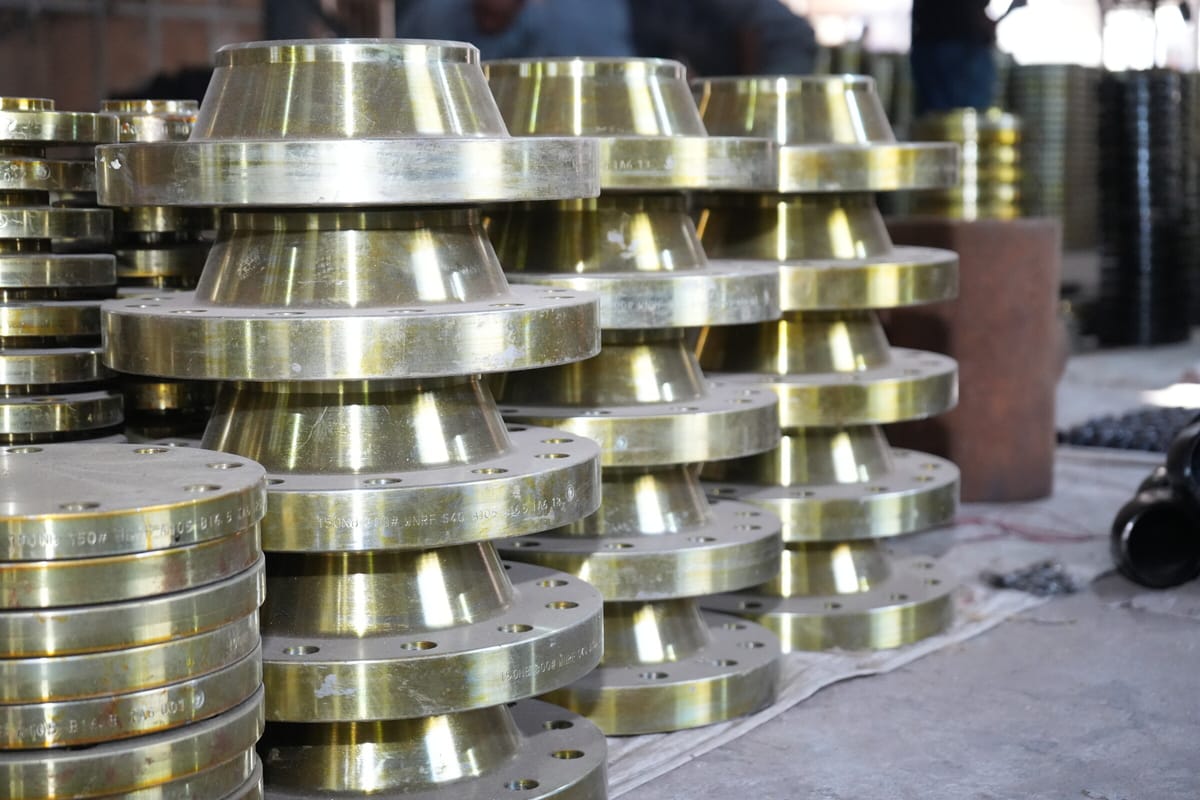
The main types of pipe flanges are weld neck, slip-on, socket weld, lap joint, threaded and blind, the six that ASME B16.5 dimensions, plus special types such as long weld neck, orifice flanges and spectacle blinds. They differ in how they join the pipe: a butt weld, fillet welds, a thread, a loose ring on a stub end, or no bore at all. We make all of them in carbon and stainless steel; for data center cooling, weld neck, slip-on, lap joint and blind flanges cover almost every joint.
Types of flanges compared
The table compares each type by how it is attached, its strength against a weld neck and where it is used. The strength figures are the classic ratios published for B16.5 flanges; the design code and the pipe decide each case.
| Type | How it joins the pipe | Strength against a weld neck | Standard | Typical use |
|---|---|---|---|---|
| Weld neck | Tapered hub butt welded to the pipe end | Reference: highest strength and fatigue life | ASME B16.5, B16.47, EN 1092-1 type 11 | Pumps, headers, vibration, high pressure, stainless clean loops |
| Slip-on | Slides over the pipe, fillet welded inside and outside | About 2/3 under pressure, about 1/3 in fatigue | ASME B16.5, EN 1092-1 type 01 (plate) | Low pressure water mains, carbon steel utility lines |
| Socket weld | Pipe end sits in a socket, one outside fillet weld | Static strength like a slip-on, fatigue about 1.5 times a slip-on | ASME B16.5, small sizes only | Small-bore vents, drains, instruments |
| Lap joint | Loose ring over a butt-welded stub end | Pressure about as a slip-on, fatigue about 1/10 | ASME B16.5; stub end ASME B16.9 or MSS SP-43 | Stainless lines with a carbon steel or lower cost ring, frequent dismantling |
| Threaded | Taper pipe thread in the bore, no weld | Limited by the threaded pipe wall | ASME B16.5, NPT to ASME B1.20.1 | Small-bore utility lines, galvanized pipe, no hot work areas |
| Blind | No bore: closes a pipe end, nozzle or valve | Most highly stressed type in large sizes | ASME B16.5, B16.47, EN 1092-1 type 05 | Header ends, spare branches, test points |
| Long weld neck | Straight extended barrel butt welded to the pipe or vessel | As a weld neck | B16.5 drilling, barrel to drawing | Nozzles on vessels, tanks and heat exchangers |
| Orifice | Weld neck, slip-on or threaded with pressure taps in the rim | As the base type | ASME B16.36 | Flow measurement with an orifice plate |
| Spectacle blind | Plate between two flanges: a disc on one end, a ring on the other | Rated to the class of the line | ASME B16.48 | Positive isolation for maintenance |
Butt-welded types: weld neck and long weld neck
A weld neck flange has a long tapered hub whose thin end matches the pipe wall, so the joint is a single full penetration butt weld that can be radiographed. The taper carries bending from thermal expansion and vibration into the flange gradually, which is why weld necks are the choice for pumps, high pressure and high or low temperature service. The bore is machined to the pipe schedule, for example Sch 10S or Sch 40, so the inside is flush.
A long weld neck replaces the short hub with a straight barrel, so the flange and a nozzle neck are one forging. It is used on vessels and heat exchangers rather than on straight pipe runs. Our weld neck flange page has the dimensions, the bore for every schedule and a drawing tool.
Fillet-welded types: slip-on and socket weld
A slip-on flange slides over the pipe and is fillet welded at the back and at the face, with the pipe set back from the face by about the pipe wall plus 3 mm (1/8 in). It is cheaper to buy and easier to line up than a weld neck, but it holds about two thirds of the internal pressure and gives about one third of the fatigue life. A slip-on also cannot be welded straight to an elbow or tee; a piece of pipe must come first.
A socket weld flange takes the pipe end into a counterbored socket and needs only one outside fillet weld. ASME B16.5 covers it in small sizes only: NPS 1/2 to 3 in Class 150, 300 and 600, and NPS 1/2 to 2 1/2 in Class 1500. A gap of about 1.6 mm (1/16 in) is left at the bottom of the socket before welding; that gap is a crevice, so some stainless and clean-fluid systems do not allow socket welds in the wetted path.
Lap joint flanges and stub ends
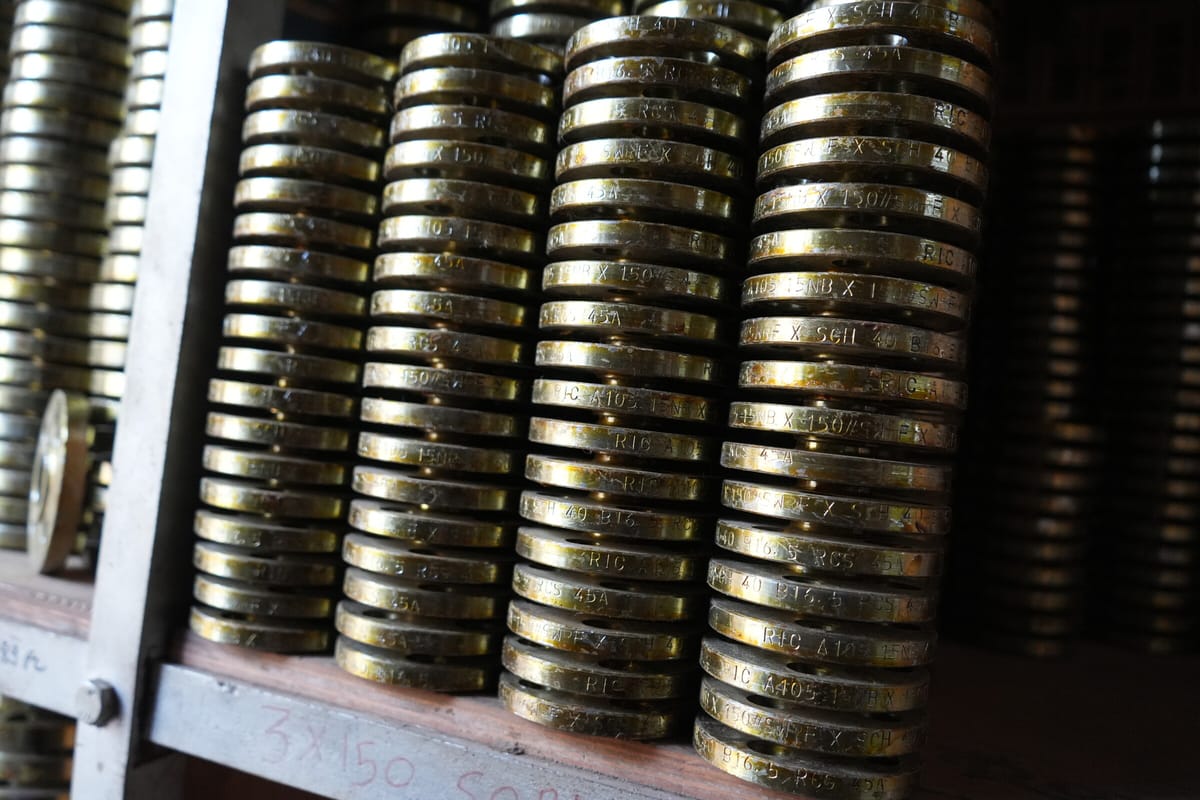
A lap joint flange is a loose ring that sits behind a stub end; only the stub end is welded to the pipe and touches the fluid. The ring swivels, so bolt holes line up without rotating the pipe, and it can be a lower cost material than the pipe, for example a carbon steel ring on a 316L stub end. The trade-off is fatigue life, about one tenth of a weld neck, so lap joints suit steady water service rather than vibrating or cycling lines. See lap joint flanges for the stub end types and dimensions.
Threaded flanges
A threaded flange screws onto pipe that has a taper pipe thread, so it needs no welding. That makes it useful on galvanized pipe and where hot work is not allowed. The thread removes a large share of the pipe wall in small sizes, about 55% at the smallest, so threaded flanges are not used on thin-wall pipe such as Sch 10S and are kept to small, low pressure lines. A seal weld is sometimes added over the thread.
Blind flanges and line blanks
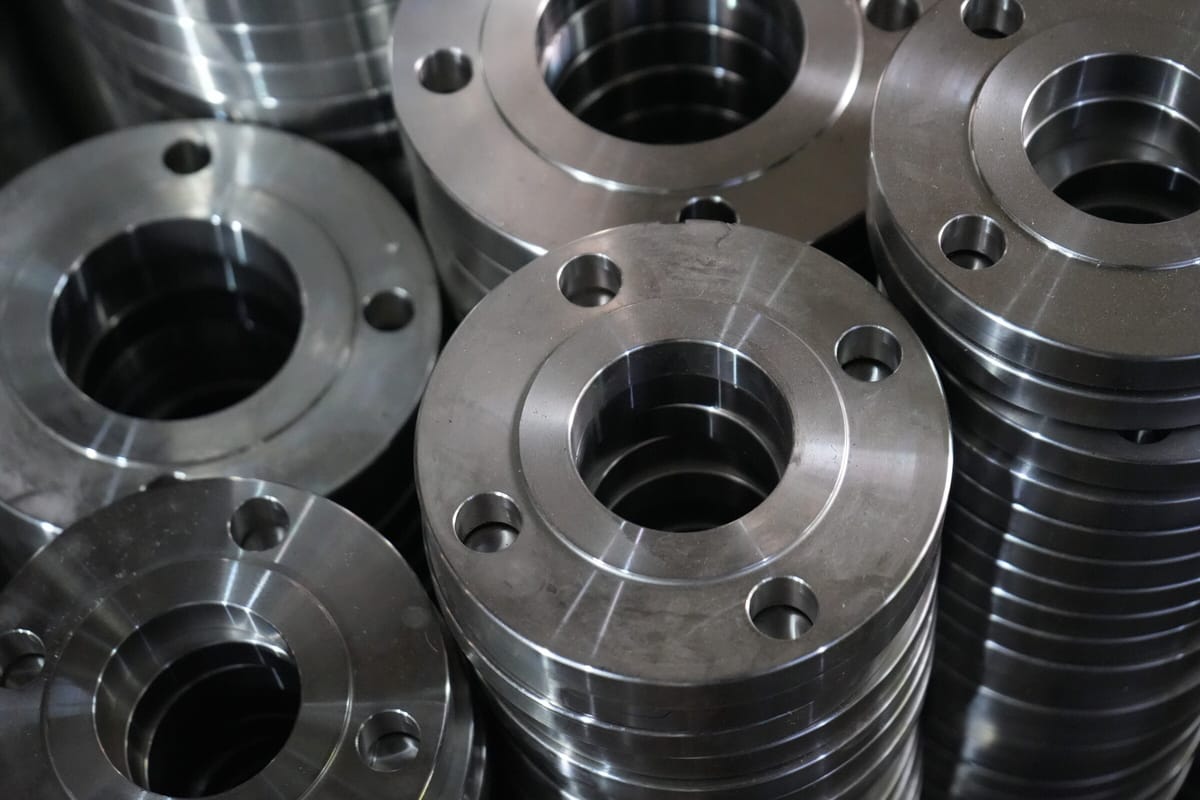
A blind flange has no bore. It closes the end of a header, a spare branch or a valve, and makes a test point for hydrostatic testing. Because the whole face carries the pressure, large blind flanges are the most highly stressed flanges in a line, and the blind must match the class, face and material of the flange it bolts to.
Line blanks sit between two flanges instead. A spectacle blind (figure 8) has a solid disc and a ring joined by a web: with the ring in the line the pipe is open, with the disc it is positively isolated. Paddle blanks and spacers do the same job in large sizes. ASME B16.48 covers them.
Special types: orifice flanges
Orifice flanges are weld neck, slip-on or threaded flanges with pressure tap holes drilled through the rim on each side of an orifice plate, and jackscrews to spread the pair when the plate is changed. ASME B16.36 covers weld neck orifice flanges from Class 300 to 2500. They are a process plant item; data center plants usually measure flow with other meters.
Face types are a separate choice
Raised face, flat face and ring type joint describe the gasket surface, not the flange type, and most types can be made with any of them. Order both: weld neck raised face, blind flat face.
| Face | Gasket | Where it is used |
|---|---|---|
| Raised face (RF) | Ring gasket inside the bolts | Steel to steel joints; the default on ASME B16.5 flanges |
| Flat face (FF) | Full face gasket with bolt holes | Cast iron, ductile iron, fiberglass and plastic equipment |
| Ring type joint (RTJ) | Metal ring in a machined groove, ASME B16.20 | High pressure and temperature, mostly Class 600 and up |
| Tongue and groove, male and female | Gasket trapped in the recess | Matched pairs where the gasket must not blow out |
When to use flat face or raised face around chillers and pumps is explained in flat face vs raised face flanges.
Which flange types a data center cooling loop uses
Data center water loops run at low pressure, mostly ASME B16.5 Class 150 or EN 1092-1 PN 16, so the choice of type turns on cleanliness, vibration and cost rather than pressure.
| Loop | Usual types | Why |
|---|---|---|
| Technology cooling system (TCS), stainless | Weld neck, lap joint on stub ends, blind | Smooth butt-welded bore, no crevices in the coolant path |
| CDU connections | Weld neck, lap joint | Matches the CDU nozzle; lap joints ease alignment |
| Chilled water mains | Weld neck at pumps and chillers, slip-on on runs, blind | Slip-on where the spec allows fillet welds; weld necks where vibration is |
| Condenser water and cooling towers | Slip-on, weld neck, flat face at cast iron and FRP | Carbon steel at low pressure; flat face to protect castings |
| Vents, drains, gauges | Socket weld or threaded on carbon steel; weld neck on stainless | Small bore; keep crevices out of the stainless clean loop |
Pressure class and material are chosen alongside the type; how to choose the pressure class and stainless vs carbon steel flanges cover those choices.
How to name the type on a line item
Write the type first, then the details that the type needs:
- Type and face: weld neck RF, slip-on RF, blind FF, lap joint with its stub end.
- Size and rating: NPS or DN, and ASME class or PN.
- Bore: the pipe schedule for weld neck and socket weld flanges; a slip-on bore follows the pipe outside diameter.
- Material: ASTM A105 or A350 LF2 carbon steel, A182 F304L or F316L stainless.
- Finish and documents: pickled and passivated to ASTM A380/A967 for stainless clean loops; an EN 10204 3.1 certificate.
Weld neck flange, raised face, DN 150 (NPS 6), ASME B16.5 Class 150, bore Sch 10S, ASTM A182 F316L, pickled and passivated to ASTM A380/A967, EN 10204 3.1. Blind flange, raised face, DN 150 (NPS 6), Class 150, ASTM A182 F316L, EN 10204 3.1.
Dimensions for each type and class can be drawn and downloaded from our flange drawings; send the schedule on our request for quote form.
Questions we get
How many types of flanges are there?
ASME B16.5 dimensions six types: weld neck, slip-on, socket weld, lap joint, threaded and blind. Long weld neck, orifice flanges (ASME B16.36) and line blanks such as spectacle blinds (ASME B16.48) are special types built on the same drilling. Face types, such as raised face, flat face and ring type joint, are a separate choice made for each of them.
Which flange type is the strongest?
The weld neck. Its tapered hub and full penetration butt weld carry pressure and bending best, and it has the longest fatigue life. Slip-on flanges hold about two thirds of its internal pressure and about one third of its fatigue life.
What is the difference between a slip-on and a weld neck flange?
A slip-on slides over the pipe and is fillet welded inside and outside; a weld neck is butt welded to the pipe end through its hub. Slip-ons are cheaper and easier to align, weld necks are stronger, can be radiographed and leave no crevice in the bore.
Which flange types suit stainless liquid cooling loops?
Weld neck flanges and lap joint flanges on butt-welded stub ends, because both leave a smooth bore with no crevice for coolant to stagnate in. Blind flanges in the same grade close headers and spare branches. Socket weld and threaded flanges leave a gap or threads in the wetted path.
Is raised face a type of flange?
No. Raised face, flat face and ring type joint describe the gasket surface, and most flange types can be made with any of them. Order the type and the face separately, for example weld neck, raised face.
References
- ASME B16.5, Pipe Flanges and Flanged Fittings, NPS 1/2 through NPS 24: flange types, socket weld size range, facings
- ASME B16.36, Orifice Flanges; ASME B16.48, Line Blanks; ASME B16.20, Metallic Gaskets for Pipe Flanges
- Wermac, Flanges: welding neck, slip on, socket weld, lap joint, threaded and blind (undated, read 3 November 2026): strength and fatigue ratios, slip-on setback, socket gap, thread wall loss