
Flanges for data center projects in Bengaluru
Bengaluru hosts almost all of Karnataka's data centers, in Whitefield, Electronic City and now Devanahalli. Its mild climate helps cooling, but the city is short of water. Here is what that means for the flanges.
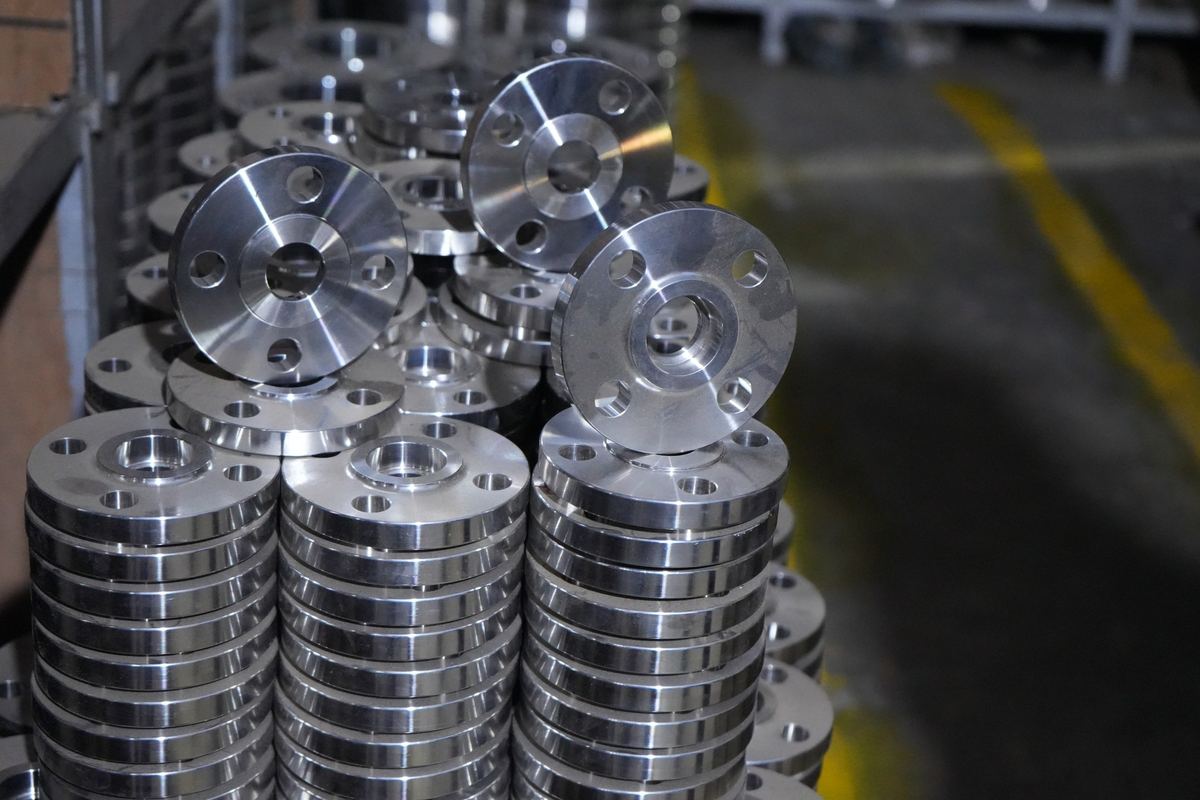
For data centers in Bengaluru we supply ASME B16.5 Class 150 flanges in A105 and 316L for chilled water, dry cooler and condenser water loops, with 316L for stainless parts in contact with recycled cooling water, and 316L flanges, pickled and passivated, for CDUs and technology cooling loops. Every heat comes with an EN 10204 3.1 certificate, and orders go by road from our works in Gujarat.
The Bengaluru data center market
Bengaluru had 162 MW of operational data center capacity in the first half of 2026 and 100 MW of upcoming supply (Cushman & Wakefield). Of Karnataka's 32 private data centers, 31 are in Bengaluru, clustered in the eastern and south-eastern tech corridors of Whitefield and Electronic City, with newer facilities at Devanahalli, north of the city (Newslaundry).
Water is the constraint. The Central Ground Water Board finds that Bengaluru draws almost ten times as much groundwater as is recharged each year, and a hydrologist quoted by Newslaundry says data centers mostly draw groundwater from deep borewells. The city's water board, BWSSB, has piloted a plant at Kadabesanahalli that turns secondary-treated sewage into cooling-grade water, and Karnataka is revising its Data Centre Policy with water efficiency as a pillar (Newslaundry).
For the piping, that points to closed loops that lose little water, more heat rejected through dry coolers, and cooling towers fed with recycled water where they are used.
Climate and what it means for the piping
| Measure | Value |
|---|---|
| Hottest month, average daily high | 34.1 °C (April) |
| Record high | 39.2 °C |
| Record low | 7.8 °C |
| Annual rainfall | 1,078 mm, 55% of it from June to September and 25% from October to December |
At about 920 m above sea level, Bengaluru is the mildest of the markets on these pages. The average daily high peaks at 34.1 °C in April and the record high is 39.2 °C; the record low is 7.8 °C, far above the -29 °C (-20 °F) to which ASME B16.5 rates A105 flanges. Rain, 1,078 mm a year, comes with both monsoons: 55% from June to September and another 25% from October to December.
Mild air gives dry coolers and economizers more hours in which they can do the work. Where cooling towers run on treated sewage water, stainless parts in contact with it are better in 316L than 304L, and carbon steel depends on the water treatment program.
Flange specification for Bengaluru projects
| System | Flange | Note |
|---|---|---|
| Dry coolers and economizer loops | A105 or 316L, ASME B16.5 Class 150, with gaskets for water or glycol | Rooftop headers painted with the pipe |
| Cooling towers on recycled water | A105, Class 150, weld neck or slip-on; flat face at cast iron pumps and FRP towers | 316L for stainless parts in the tower water |
| Chilled water plant and facility water | A105, Class 150 RF; ASME B16.47 above NPS 24 | Insulate flanges with a vapor barrier |
| CDUs and technology cooling system | 316L, Class 150, weld neck or lap joint with stub end, pickled and passivated, 100% PMI | Same grade as the pipe; no slip-ons on the TCS |
Every flange is stamped with its grade, size, class and lot number and ships with an EN 10204 3.1 certificate. Send us your line list and we quote each line as specified.
Getting flanges to Bengaluru
Flanges for Bengaluru projects go by road from our works in Umbergaon, Gujarat, to the site, your contractor's yard or a fabrication shop in and around the city.
Domestic orders are invoiced with GST and travel with an e-way bill. Your engineer or third-party inspector is welcome at the works before dispatch. Supplying data center projects in India covers standards, inspection and ordering.
Flanges for other Indian data center markets: Mumbai, Hyderabad, Chennai, Delhi NCR, Pune, Visakhapatnam.
Frequently asked questions
How does water scarcity change the flange specification?
It changes the materials more than the ratings. Closed loops with dry coolers use little water, and their flanges are standard A105 or 316L to ASME B16.5 Class 150. Where cooling towers run on treated sewage water, specify 316L for stainless parts in contact with it.
Which flanges suit rooftop dry cooler headers?
A105 or 316L to ASME B16.5 Class 150, with gaskets suited to the loop fluid, water or a glycol mix. Rooftop headers are outdoors, so paint carbon steel flanges with the pipe once the joint is tested. See gaskets for water and glycol loops.
Can you deliver to Devanahalli or Electronic City?
Yes. Orders go by road from our works in Gujarat to any site in and around Bengaluru, or to your contractor's yard, with a GST tax invoice and an e-way bill.
Sources
- Cushman & Wakefield, India Data Centre H1 2026 update (23 September 2026)
- Newslaundry (from The News Minute), In Bengaluru's water-stressed areas sit most of its data centres (16 April 2026)
- India Meteorological Department 1991 to 2020 normals and records for Bengaluru, as tabulated in Wikipedia's climate table
- ASME B16.5, Pipe Flanges and Flanged Fittings: pressure-temperature ratings