
Butterfly valves for data center CDU and header isolation
Butterfly valves isolate the big lines of a liquid cooling loop: each CDU, the headers and every row manifold. They are short, light and quick to operate, and they bolt between two flanges of the line's class.
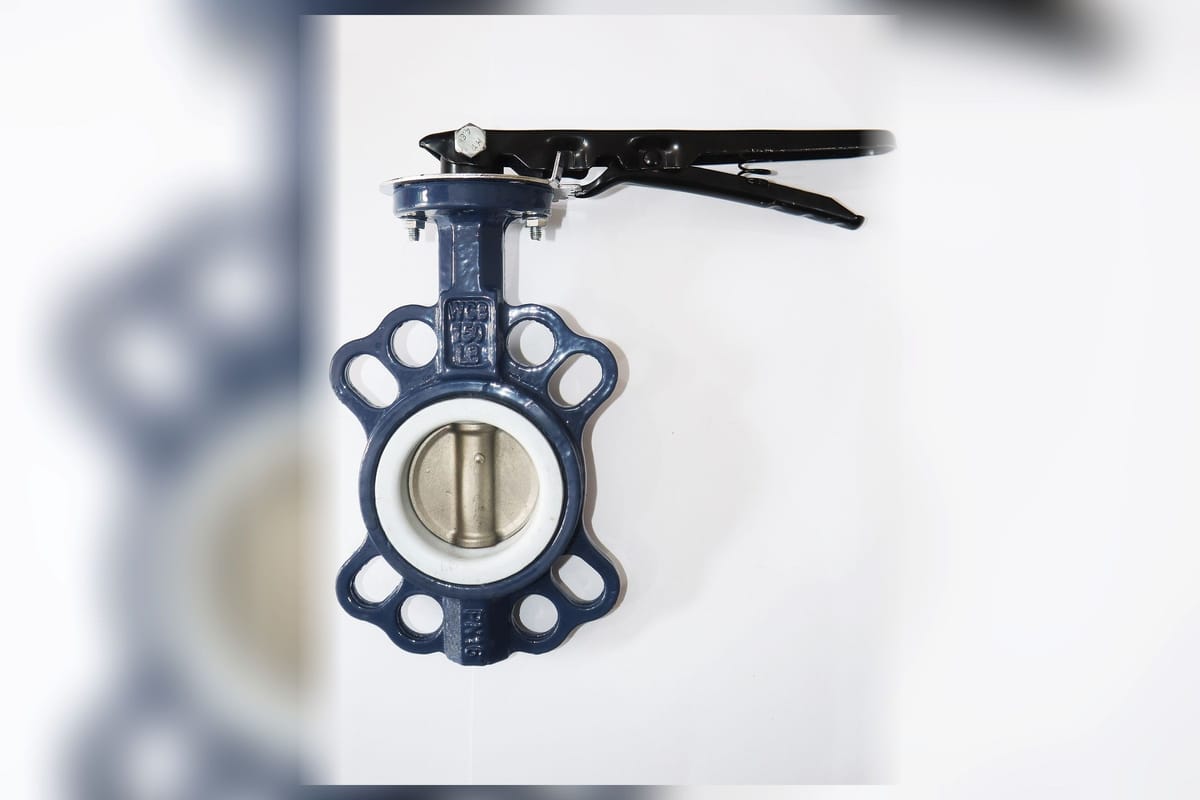
For data center liquid cooling, use lug-type stainless butterfly valves to isolate each CDU and the headers, and lug or wafer valves on row manifolds, in SS 316L or 304L with EPDM seats, bolted between weld neck flanges of the line's class: ASME B16.5 Class 150 or EN 1092-1 PN 16. We make those flanges; this page covers where the valves go and what they need from the flanges.
Where butterfly valves sit in a cooling loop
| Location | Pattern | Why |
|---|---|---|
| CDU secondary connections | Lug | The CDU can be removed for service with the header still full |
| CDU primary connections | Lug | Separates the CDU from the facility water |
| CDU header, between CDUs | Lug | Lets one section be drained for a new CDU tie-in |
| Row manifold inlet | Lug or wafer | Isolates a row; lug if the row will be cut in later |
| Chilled and facility water branches | Lug or wafer | Isolation at air handlers, CDUs and future connections |
In our sample BOQ for a 20-rack pod, twelve butterfly valves isolate four CDUs and two row manifolds; the forty rack branches use ball valves.
Lug or wafer
| Lug | Wafer | |
|---|---|---|
| How it is held | Each bolt passes through or into a lug on the body | Clamped between two flanges by through-bolts |
| Dead-end service | Yes, within its dead-end rating: one side can be disconnected | No: both flanges must stay bolted |
| Weight and cost | Heavier, higher cost | Lighter, lower cost |
| Typical use | CDU connections, equipment, future tie-ins | In-line isolation where both sides stay put |
Flanges for a butterfly valve
The valve takes its drilling from the flanges, so the bolting is that of the line's class. For the common sizes:
| Size | Class 150: bolts on bolt circle | PN 16: bolts on bolt circle |
|---|---|---|
| NPS 2 (DN 50) | 4 × 5/8 in on 120.6 mm | 4 × M16 on 125 mm |
| NPS 2-1/2 (DN 65) | 4 × 5/8 in on 139.7 mm | 8 × M16 on 145 mm |
| NPS 3 (DN 80) | 4 × 5/8 in on 152.4 mm | 8 × M16 on 160 mm |
| NPS 4 (DN 100) | 8 × 5/8 in on 190.5 mm | 8 × M16 on 180 mm |
| NPS 6 (DN 150) | 8 × 3/4 in on 241.3 mm | 8 × M20 on 240 mm |
| NPS 8 (DN 200) | 8 × 3/4 in on 298.4 mm | 12 × M20 on 295 mm |
| NPS 10 (DN 250) | 12 × 7/8 in on 361.9 mm | 12 × M24 on 355 mm |
| NPS 12 (DN 300) | 12 × 7/8 in on 431.8 mm | 12 × M24 on 410 mm |
- Weld neck flanges bored to the pipe schedule are the usual pairing: the bore is smooth and the disc has room to swing. Draw them to scale on our weld neck flange page.
- Disc clearance: the disc swings into the pipe on both sides. Check it against the bore of slip-on flanges and the stub ends of lap joint flanges before choosing them.
- Gaskets: many butterfly valves seal on their own seat, without separate flange gaskets; follow the valve maker's instruction for each model.
- Studs: lug valves take a set of studs or cap screws on each side; wafer valves take long through-bolts. Lengths depend on the valve body, so they come with the valve's data.
Materials and seats
On the technology cooling loop, body and disc are SS 316L or 304L, in the same family as the pipe. EPDM seats suit water and propylene glycol mixes such as PG25; Vertiv recommends peroxide-cured EPDM for elastomers in single-phase TCS loops. On chilled water, the same valves fit stainless facility water mains. Sanitary butterfly valves with tri-clamp or weld ends suit CDUs with sanitary connections; see tri-clamp fittings.
Butterfly valves on metric specifications
On European specifications, butterfly valves are made to EN 593 and pressure tested to EN 12266-1, and the drilling follows EN 1092-1. PN 10 and PN 16 share their drilling up to DN 150, but from DN 200 they differ, so check whether the valve is drilled PN 10 or PN 16 before ordering flanges. Our EN 1092-1 page draws the flanges for either.
Frequently asked questions
Lug or wafer butterfly valve for a CDU?
Lug. A lug valve has threaded or through holes for each bolt, so the piping on one side can be removed with the line on the other side still under pressure, within the valve's dead-end rating, which is what isolating a CDU for service needs. A wafer valve is clamped between two flanges by through-bolts and cannot hold one side alone.
Which flanges does a butterfly valve need?
Two flanges of the line's class with a bore large enough for the disc to swing: weld neck flanges bored to the pipe schedule are the usual choice. Slip-on flanges can foul a disc if the pipe end sits too close, and lap joint stub ends must be checked against the disc too.
Which seat suits a water-glycol coolant?
EPDM is the usual seat for water and propylene glycol; Vertiv recommends peroxide-cured EPDM for elastomers in single-phase technology cooling loops. Check the seat against the coolant supplier's approved materials list.
What sizes are used in a liquid cooling loop?
In a pod of AI racks, about NPS 4 to 8 (DN 100 to 200) at the CDUs, headers and row manifolds, and larger on the facility water mains. Small CDUs with sanitary connections may use tri-clamp butterfly valves of 2.5 in and up instead of flanged ones.
Sources
- Vertiv, Guidelines for Deployment of Single Phase Technology Cooling System, SL-80056 Rev A, February 2025 (elastomers)
- ASME B16.5, Class 150 flange drilling; CEN, EN 1092-1:2018, Table 13 (PN 16 drilling)
- EN 593, metallic butterfly valves; EN 12266-1, pressure testing of metallic valves
- RIC, sample bill of quantities in the CDU to rack piping guide