
Grooved couplings vs flanges in data center cooling piping
Grooved couplings and flanges often share one drawing: grooved joints on the steel mains, flanges at the chillers, pumps, valves and CDUs. This guide compares the two on rating, movement, materials and codes, and shows how to specify the flange where they meet.
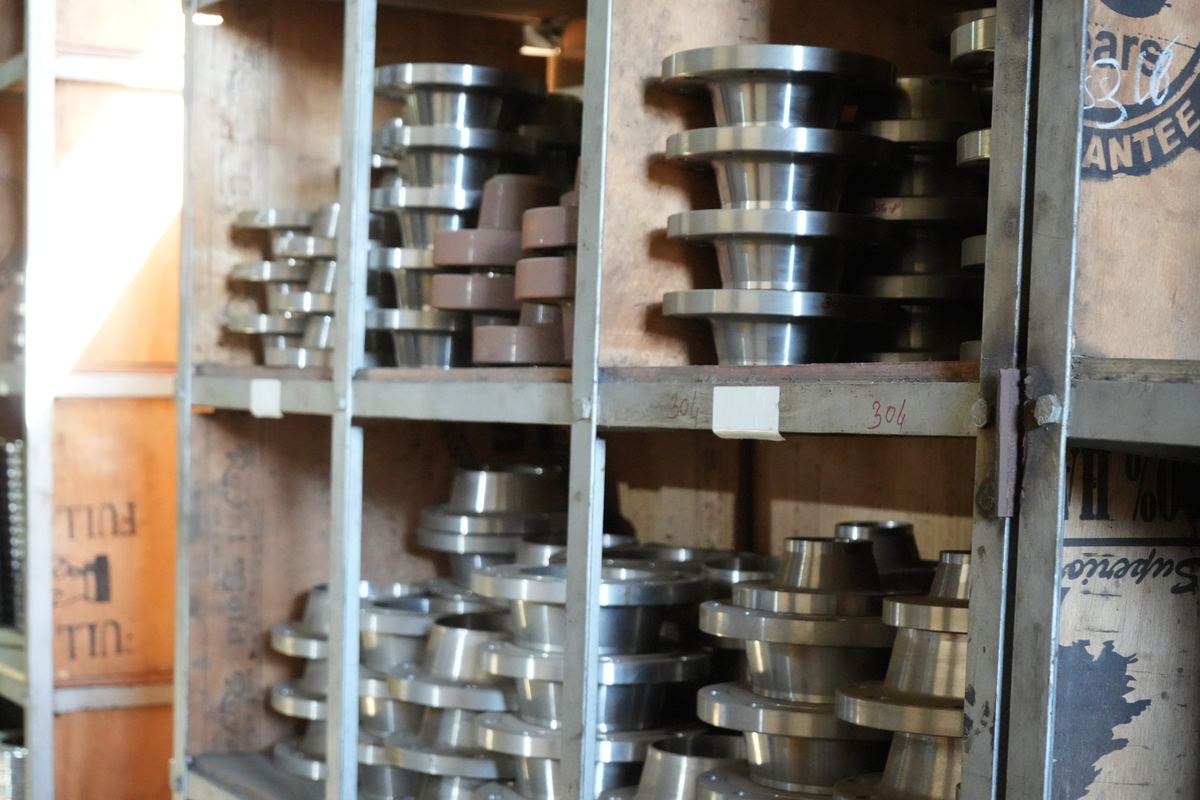
Grooved couplings suit carbon steel chilled water and condenser water mains, where fast assembly and access for maintenance matter. Flanges stay wherever the pipe meets flanged equipment, such as chillers, pumps, valves and CDU nozzles, and on light-wall stainless lines, where a grooved joint can be rated well below a Class 150 flange. RIC makes those flanges: A105, 304L and 316L to ASME B16.5, weld neck, slip-on, flat face and blind.
Grooved couplings and flanges side by side
A grooved joint clamps two grooved pipe ends in a bolted housing over a rubber gasket. A flanged joint bolts two flanges, welded to the pipe, together over a gasket.
| Attribute | Grooved coupling | Flanged joint |
|---|---|---|
| Parts per joint | Two ductile iron housings, a gasket and two bolts (Victaulic Style 77) | Two flanges, a gasket and a full set of stud bolts |
| Standard | AWWA C606; groove sizes and ratings from the coupling maker | ASME B16.5 to NPS 24, B16.47 above; EN 1092-1; AWWA C207 and C228 |
| Movement | None if rigid; flexible couplings allow expansion, contraction and deflection | None; loops, expansion joints or flexible connectors take it |
| Rating, 4 in carbon steel | 69 bar (1,000 psi), Style 77 on standard wall pipe | 19.6 bar (285 psi), A105 Class 150 at -29 to 38 °C (-20 to 100 °F) |
| Light-wall stainless | Light-wall roll sets; ratings fall as the wall thins | Bore matched to Sch 10S or 40S; the flange class sets the rating |
| Gasket | Molded EPDM, for example Grade E at -34 to 110 °C (-30 to 230 °F) | EPDM, PTFE or CNAF, ring or full face |
| Access and checks | Two bolts to open; grooves gauged; bolt pads meet metal to metal | All bolts out to open; holes must line up; tightening sequence such as ASME PCC-1 |
A Pumps & Systems comparison cites installation up to six times faster than flanging. Flanges are slower to bolt up, but their rating comes from the flange standard, not the pipe wall and groove.
Why the joint choice matters in data center cooling piping
A leak in a data center can reach IT equipment, so owners care where mechanical joints sit. On Eng-Tips, an engineer reported coupling bolt failures that caused major chilled water leaks at two data centers within five years; replies ranged from avoiding mechanical joints under raised floors to finding well-installed couplings reliable.
UFGS 23 64 26 (November 2025), the US federal guide specification for chilled and condenser water piping, allows rigid grooved joints only in serviceable, aboveground locations at up to 110 °C (230 °F). It keeps grooved joints out of concealed spaces without an access panel and wants each joint's housing, gasket and bolts from one maker; these clauses apply to Army and Air Force projects, not NAVFAC. It also asks for a union or flanged joint just before each pump, coil or control valve.
Where each joint fits, loop by loop
Grooved couplings appear mainly on steel mains; flanges appear at every flanged component and across the stainless TCS.
| Loop | Grooved couplings | Flanges | Flange to order |
|---|---|---|---|
| Condenser water and cooling towers | Steel mains and risers (AWWA C606 covers 3/4 to 24 in) | Towers, pumps and valves; flat face at cast iron and fiberglass | A105 Class 150, flat or raised face |
| Chilled water and facility water mains | Carbon steel headers, mains and risers | Chillers, pumps, strainers, flanged valves; blind ends for future halls | A105, or 304L and 316L, Class 150 |
| CDU connections | Only where the nozzle is grooved | Flanged nozzles on both sides | 316L or 304L weld neck to the nozzle class and face |
| Technology cooling system (TCS) | Possible with light-wall roll sets; check ratings and gaskets | CDU secondary nozzles, headers, valves and manifold ends | 316L weld neck or lap joint, pickled and passivated |
Every TCS gasket is wetted. The Open Compute Project's PG25 guideline (September 2026) recommends peroxide-cured EPDM, since sulfur-cured EPDM can add sulfate to the coolant. More in flange gaskets for water and glycol loops.
Grooved systems still end in flanges
Where a grooved main meets a flanged chiller, pump, valve or CDU, the transition is a grooved flange adapter or a short spool with a welded flange. Victaulic's Style 741 adapter (2 to 24 in) bolts to Class 125 and 150 flanges, rated 20.7 bar (300 psi) on carbon steel pipe; Style 743 (2 to 12 in) bolts to Class 250 and 300, rated 49.6 bar (720 psi). Both are rigid. Style 741 also comes in PN10 and PN16 drilling from DN50 to DN300.
- The face. The adapter needs a smooth, hard mating face. Against a serrated face, such as the standard B16.5 raised face of 3.2 to 6.3 µm Ra (125 to 250 µin), Victaulic adds a flange gasket and a metal flange washer; rubber-faced flanges and rubber-lined wafer valves take the washer alone.
- The layout. Two adapters should not sit within 90 degrees of each other on a standard fitting, and they should not anchor tie rods across unrestrained joints.
- The rating on stainless. On light-wall stainless the adapter can be rated below the flange; the joint takes the lower rating.
| Size and pipe | Style 741 flange adapter (Victaulic 17.09) | 316L Class 150 flange at -29 to 38 °C (-20 to 100 °F) |
|---|---|---|
| 4 in, Sch 10S, roll grooved | 19.0 bar (275 psi) | 15.9 bar (230 psi) |
| 6 in, Sch 10S, roll grooved | 8.6 bar (125 psi) | 15.9 bar (230 psi) |
| 6 in, Sch 40S, cut grooved | 17.2 bar (250 psi) | 15.9 bar (230 psi) |
| 8 in, Sch 10S, roll grooved | Not rated | 15.9 bar (230 psi) |
| 8 in, Sch 40S, cut grooved | 13.8 bar (200 psi) | 15.9 bar (230 psi) |
From 6 in up on Sch 10S, the adapter is rated well below the flange, or not at all. A weld neck flange butt welded to the pipe keeps the Class 150 rating. Check each figure against the design pressure with static head; Victaulic allows 1.5 times its rating for a one-time field test.
How to specify the flanges in a grooved system
List each flange at a grooved transition as its own line item:
- Class: ASME B16.5 Class 150 for Class 125/150 adapters, Class 300 for Class 250/300, and flat face flanges at cast iron equipment.
- Face: say the flange mates with a grooved flange adapter and give the finish its maker asks for; otherwise we supply the standard serrated raised face.
- Material: A105 on carbon steel; 304L or 316L on stainless, pickled and passivated to ASTM A380/A967 for the TCS.
- Bore: the pipe schedule, such as Sch 10S, so the weld neck meets the pipe without a step.
- Certificate: EN 10204 3.1, with grade, size and lot number stamped on each flange.
Weld neck flange, ASME B16.5 Class 150, NPS 6, bore Sch 10S, ASTM A182 F316L, pickled and passivated to ASTM A380/A967, EN 10204 3.1. Mates with a Class 125/150 grooved flange adapter: face finish to the adapter maker's instructions.
Frequently asked questions
Are grooved couplings allowed on data center chilled water piping?
Usually, yes, within the owner's specification. UFGS 23 64 26 allows rigid grooved joints only in serviceable, aboveground locations at up to 110 °C (230 °F). Some designers avoid mechanical joints under raised floors, where a leak reaches IT equipment.
Can a grooved flange adapter bolt to a raised face flange?
Yes, with a flange gasket and a metal flange washer, because the standard B16.5 raised face is serrated and the adapter needs a smooth, hard face. Tell us at order if the adapter maker wants a different finish.
Is a grooved joint rated as high as a Class 150 flange?
On standard wall carbon steel, usually higher: 69 bar (1,000 psi) for a 4 in Style 77 coupling against 19.6 bar (285 psi) for an A105 Class 150 flange. On 6 in Sch 10S stainless, a Style 741 flange adapter is rated only 8.6 bar (125 psi).
Should the technology cooling system be grooved or flanged?
Follow the CDU and owner specifications. Grooved stainless is possible, but Sch 10S ratings fall with size and every gasket is wetted. Butt-welded stainless with weld neck or lap joint flanges keeps the full flange rating and a smooth bore.
Sources
- Victaulic Publication 17.09, performance data for stainless steel pipe, Rev S, June 2026
- Victaulic Publication 06.06, Vic-Flange adapters Styles 741 and 743, Rev AA, August 2026
- Victaulic Publication 06.04, Style 77 flexible coupling, Rev Y, September 2026
- UFGS-23 64 26, Chilled, Chilled-Hot, and Condenser Water Piping Systems, November 2025 (2.2.2.4, 3.1.4.4, 3.1.4.6)
- AWWA C606-22, Grooved and Shouldered Joints
- Open Compute Project, PG25 heat transfer fluid guidelines, Revision 2.0, September 2026 (Table 4)
- ASME B16.5, Pipe Flanges and Flanged Fittings: ratings and raised face finish
- Pumps & Systems, Grooved Versus Flanged Connections (undated, read 20 October 2026)
- Eng-Tips thread 375272, grooved coupling failures in data center chilled water (read 20 October 2026)